Artist Residency
With Run Jiang
Musée Bernard Boesch
La Baule, 2026


“For this residency, from January 21st to March 29th of 2026, the city of LA BAULE-ESCOUBLAC is pleased to welcome for the first time two contemporary artists with complementary approaches.
Run Jiang and Luís Almeida develop artistic and visual reflections on the imagination and our propensity to dream and escape through contemporary drawing. During this period, they will alternate in the artist residency, allowing visitors to explore new graphic avenues.
Their work highlights a simplicity of line and form, in the noblest sense of the term, made possible by charcoal, paint and dry pastel. Paradoxically, they conceive of a dense universe, composed of familiar figures, akin to a mythological and dreamlike narrative. Through their collaborative work, reality and our certainties seem to slip away like a fleeting thought, giving way to a surreal impression.
Among the references we can discern in their respective projects, there is notably a primitive, even naive, influence in their artistic gesture and treatment of lines.
Finally, their residency reflects a daily artistic production, as they create all the drawings included in the exhibition on-site, while also offering visitors participatory workshops. Beyond questioning our relationship to intimacy, Run Jiang and Luís Almeida deliver personal messages here, imbued with poetry, that everyone can make their own.”
Quentin Mercier
Responsible of the Musée Bernard Boesch
“Infância Reconquistada”
Solo exhibition
Gallery Braço Perna 44
Lisbon, 2026


Luís Almeida: "Infância Reconquistada"
Luís Almeida’s paintings have an uneasy joyfulness to them. His narratives occupy the space between pure, unfiltered emotion and wild interpretations run amok.
Almeida creates an alternate space where the act of painting churns, spews and whips around the canvas until reality is overtaken, leaving the outside world in its wake. His subjects push through the edge of representation, forming a new bio-logic based on instinct. Yet, with all his gnarly techniques and bizarre color theory, the resulting vignettes remain almost completely without judgement – a purity of thought on canvas without the fuss of overthinking one rarely sees in Contemporary Art.
Almeida is the quintessential observer/translator, reacting solely in the studio where the loaded brush meets the waiting canvas – that physical application of paint in an electrified moment beyond his initial observations to an alternative world. There is a lot of discussion by physicists today, of as many as 11 unifying forces that make up our universe. The way Almeida breaks down and reconstructs his constantly shifting and morphing subject matter surely passes through some of this extended space physics advance.
Take for instance the painting “O Cavaleiro Chinês”. Here we see a bucking horse protesting the sword of its rider as it threatens to behead someone hanging onto the horse’s leg below. What initially draws the eye into this whirlwind of motion is the purity of the diamond-shaped white form that the rider and the horse share. This relatively ‘clean’ space promises to offer safety in an otherworldly place, but the protagonist in this drama has other ideas in mind. In the end, it’s the three areas of blue that create a classic pyramid of stability that keeps this topsy turvy composition from exploding outwardly.
“Família Feliz” has its share of tension as well, only in this instance it is overpowered by love. Challenging this state of bliss in the background, where we have a few indications of the seedier side of life rendered in drippy washes of color. Additionally, a sinister hand creeps in through the bottom right of the composition to create more tension. Despite all the unwanted intrusions to this otherwise buoyant scene, it is the love of family signified by a new born babe that keeps the positivity afloat.
“Fim de Semestre” has its own, more subtle brand of bizarreness. Almeida reigns in his energy level just enough to focus the narrative to the more mundane aspects of life. We have all seen group photos of children related by some function or form. I am guessing this one is related to a sporting event where the teacher/coach and the school principal are overseeing the proceedings. Oddly, the principal, if that is who he is, with his dark sunglasses and a black suit, looks more like a security guard than an educator. What is most fascinating in “Fim de Semestre” are the individual faces and how they all express such completely different personalities. Shy, confused, happy, lost in thought and miserable, each child commands their allotted space while their uniform dress and the similarly colored background creates a profound push/pull effect.
Luís Almeida, a painter 's painter who challenges himself as much as he does the viewer.
D. Dominick Lombardi
“Heads Will Roll”
Solo exhibition
Gallery Braço Perna 44
Lisbon, 2024


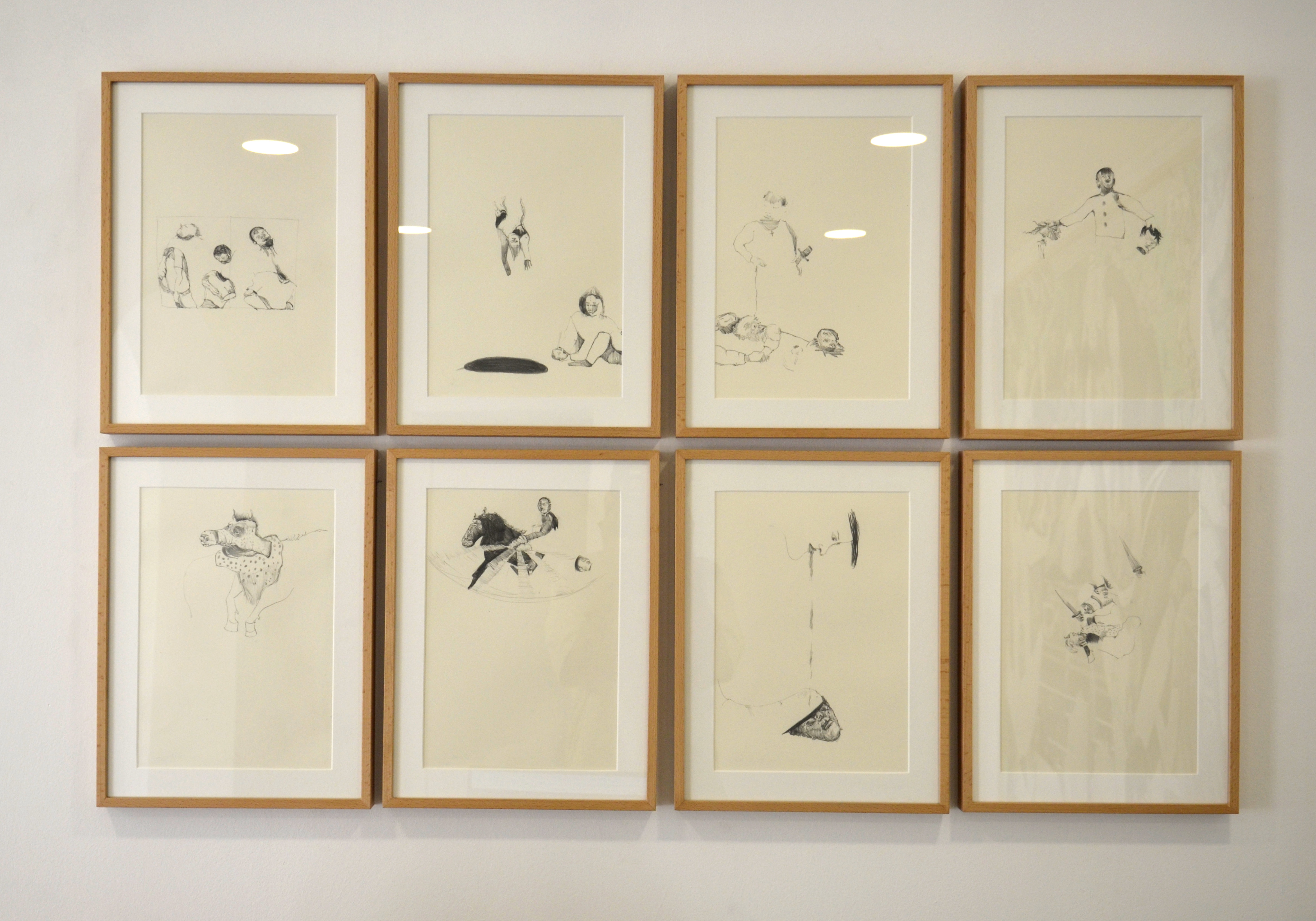
“Reflecting on the Drawings of Luís Almeida”
To view Luís Almeida’s drawings is to enter a world of endless, narrative possibilities.
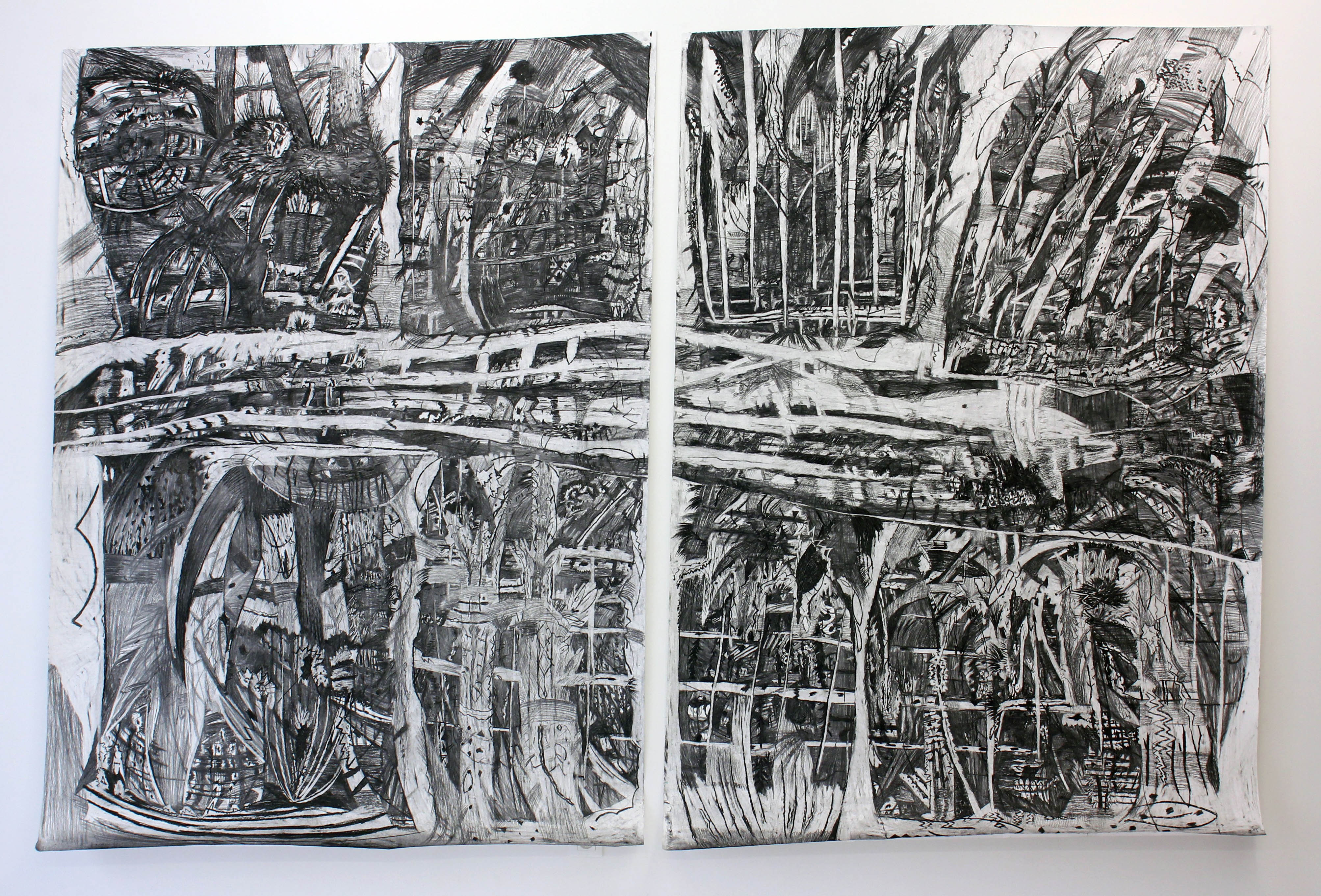
I had the unique privilege of watching Luís, create the large-scale, charcoal works on exhibition here. Both of us were awarded art residencies at Córtex Frontal, an artists’ retreat in Arraiolos. We worked in adjacent studios. Frequently we would visit one another’s spaces, exchange ideas, and ask questions about works-in-progress.
Additionally, I was able to observe Luís’s fascinating, working process. Luís would enter the studio in the morning, sit, and observe his drawings for a period of time before making any marks. Because of the scale of the work, he would often be seated ten meters from a drawing. Then he would “enter” the work, like a choreographer mapping out a series of dance movements.
Another aspect of Luís’s studio practice is the manner in which he draws. Working with small sticks of charcoal, countless sticks of charcoal, he builds up areas that are tonal, then linear, and then textural. Luís elicits from these simple tools an extraordinary array of distinctive and expressive marks. The drawings develop over an extended period of time.
The role that space plays within Luís’s work cannot be over emphasized. Luís employs an open space the way that a composer uses a pause. I have seen undeveloped areas of the drawings exist for several days before Luís “enters” into the space with his charcoal and transforms an empty plane into a receding staircase, an advancing figure, or something totally unexpected.
Content is perhaps the most intriguing aspect of Luís’s work. I interpret these complex narratives as open ended. By that I do not mean incomplete or inchoate; rather, I mean that the drawings provide the viewer with myriad possibilities for interpretation and engagement. This level of complexity, without leading to confusion, speaks to Luís’s clarity of thought, and his ability to realize those thoughts in an articulate, visual language. In conversations with Luís, art history and contemporary art were common topics. It is obvious when looking at Luís’s work that his vast knowledge of art and its encyclopedic options have been internalized and synthesized to lead to these drawings. The works are distinctly Luís’s.
To the viewer, I offer a piece of advice: Allow yourself time to ponder Luís’s drawings. Return to them often, because there is always more to be seen.
Nicholas Hill
Artist
Granville, Ohio, USA
“Caylus”
Solo exhibition
MU.SA - Museum of Arts
Sintra, 2024
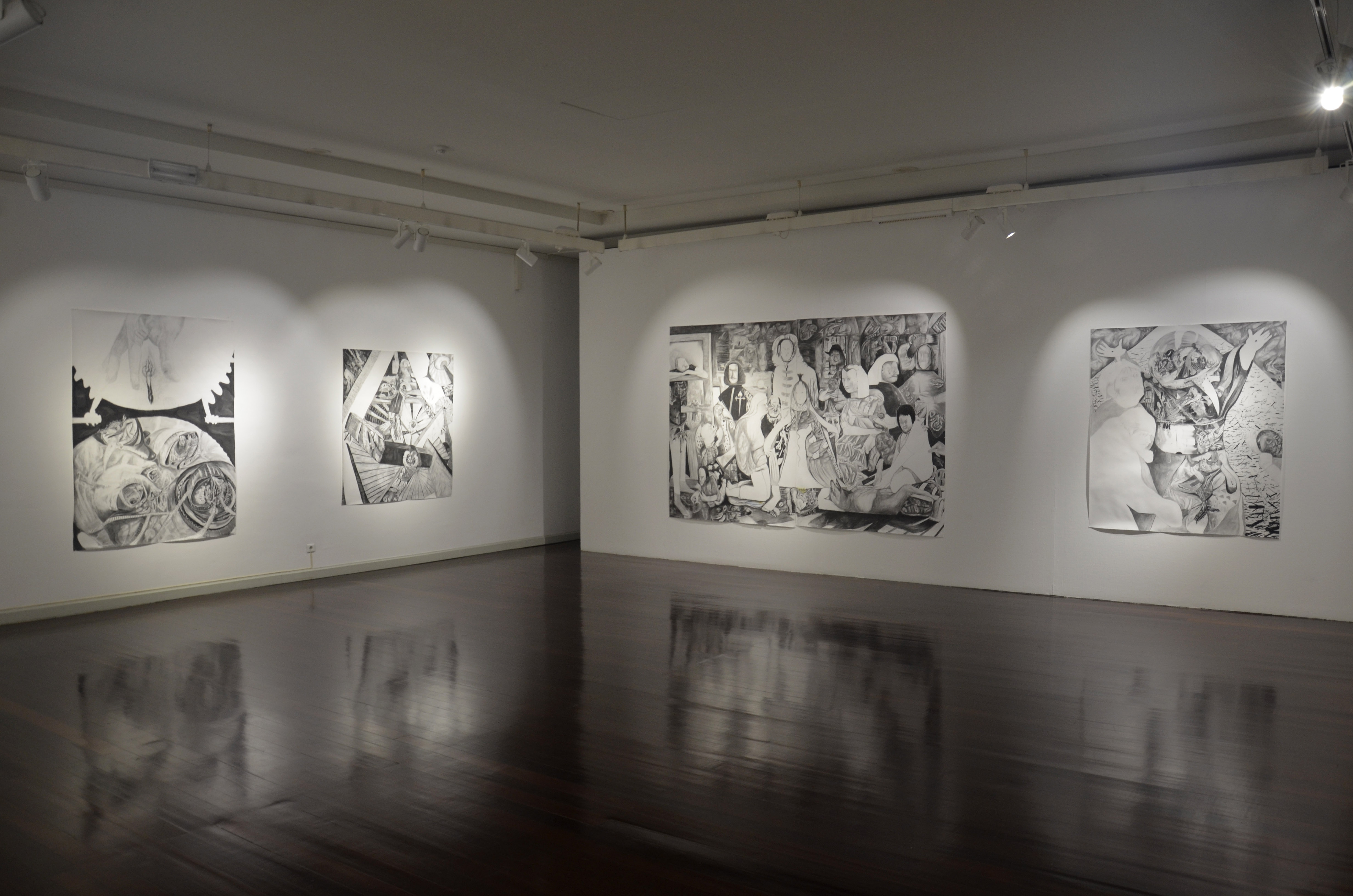
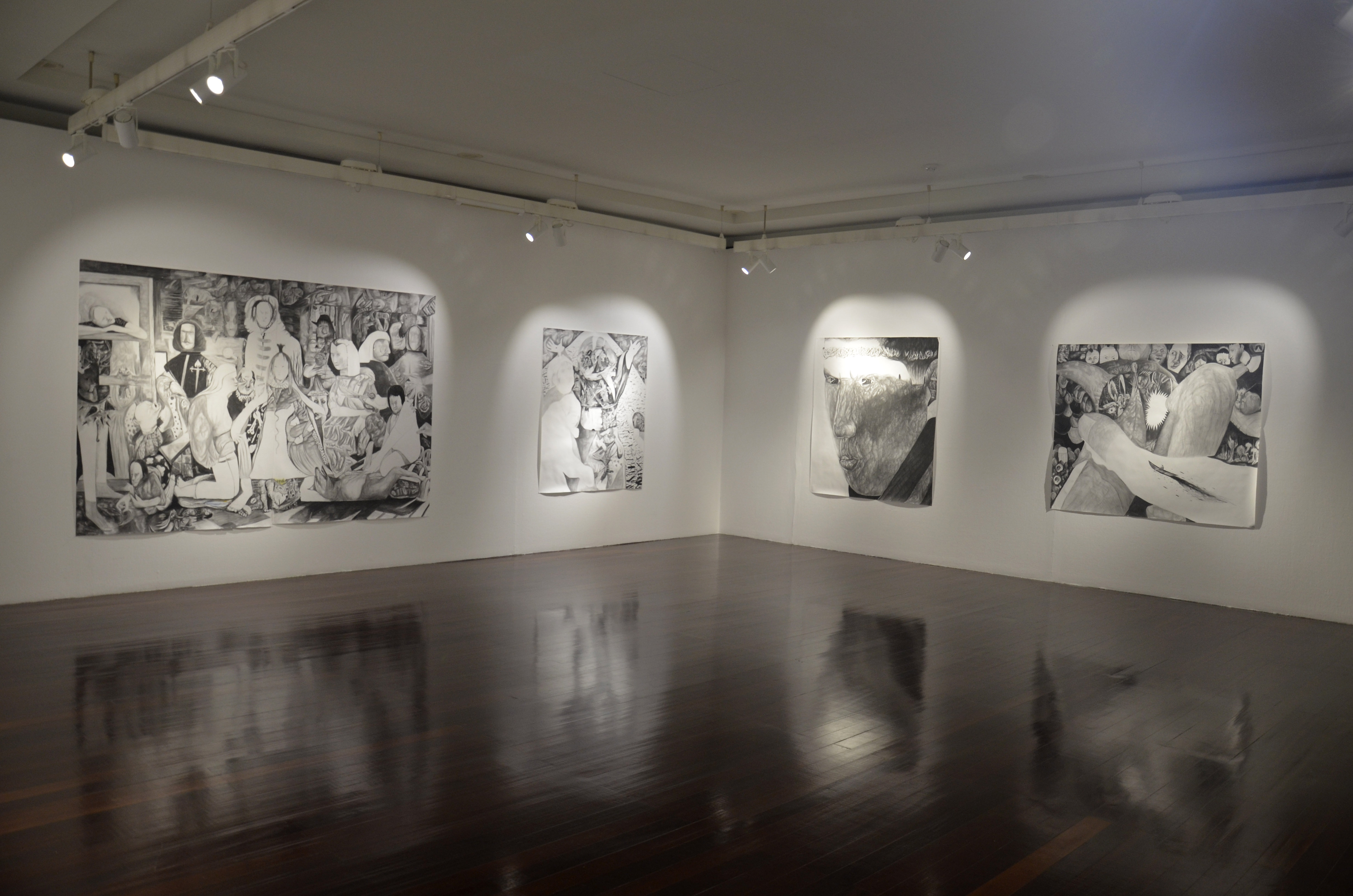
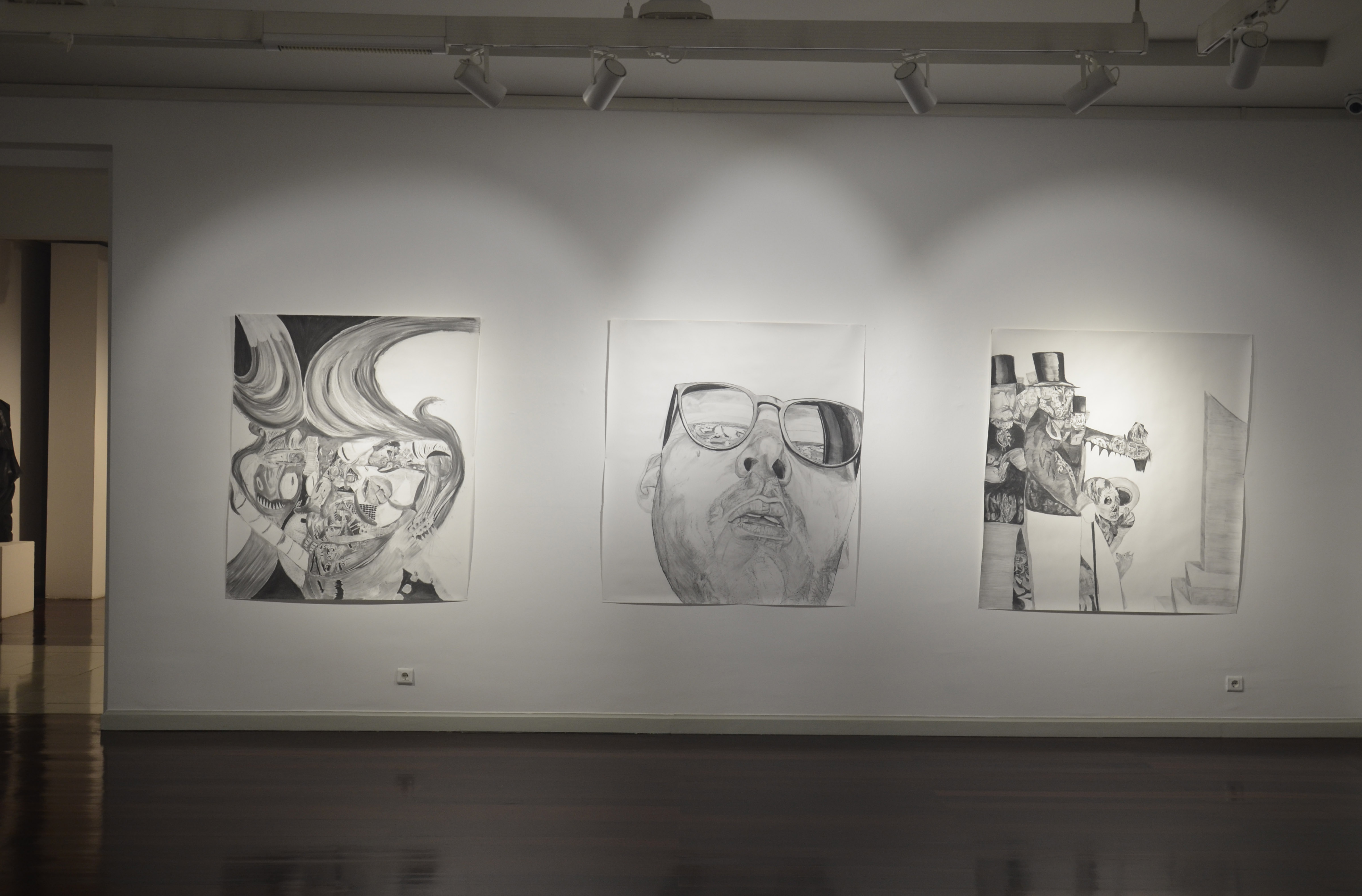
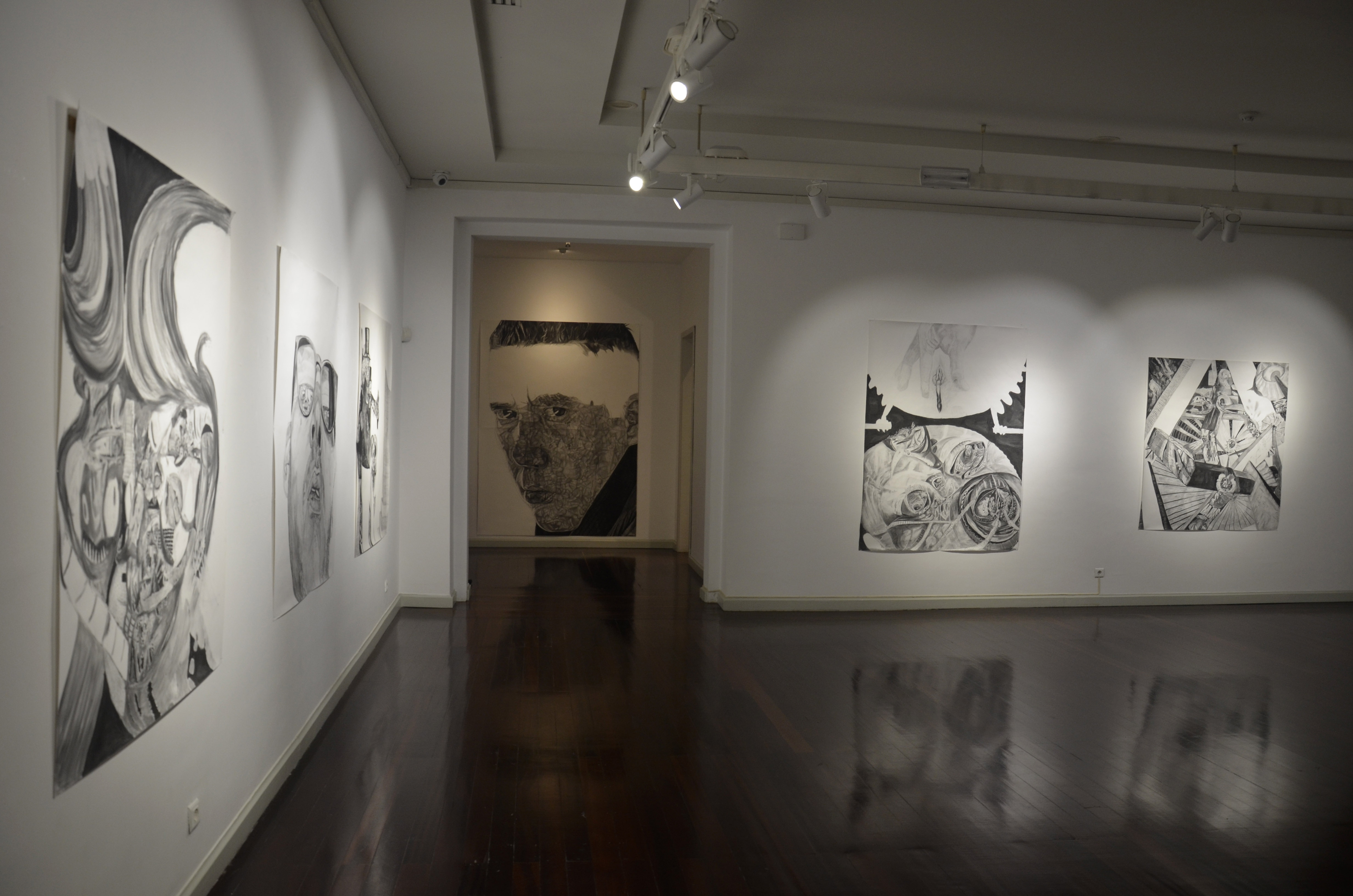

Why Caylus?
Caylus is a village located in the Occitanie region of France. It was there, at DRAW International, that I spent six weeks completing a residency. I chose this title because it marks the starting point for this series of drawings. In Caylus, I sought to create quick drawings on a smaller scale than my usual work, with an experimental intent to break new ground in terms of methods and processes.
On the two walls flanking the entrance, you will find drawings made during the residency. In one, “As Vigas” (The Beams), I drew inspiration from the medieval beams that crowned my bedroom ceiling. Every day, in the late afternoon while resting on the bed, I would look at them, draw them, and hope the woodworm-eaten timber wouldn't collapse on top of me. Beside it, “Opération Dépersonnage” stems from an "operation" to curb the village's excessive pigeon population by force. At night, poachers armed with air rifles roamed the streets, gunning down the poor birds under the cover of darkness—it was called “Opération Dépigeonnage.” In honor of the poor pigeons, I imagined their revenge in this “Opération Dépersonnage”; the pigeons take their vengeance with foul-smelling excrement, but they need a helping hand.
On the adjacent, larger wall, is the "Wall of Masters." It has become a recurring habit of mine to draw inspiration from masterpieces of art history. Thus, artists such as Goya and Velázquez have influenced my recent visual research. In this case, I freely appropriated two iconic paintings: “The Third of May” (Goya, 1814) and “Las Meninas” (Velázquez, 1656).
Following the path along the wall, we come across the “Wall of Little Exercises.” My parents-in-law visited us this summer, and every night after dinner, we would set ourselves simple drawing exercises as a family activity. Taking these "simple" exercises, I decided to explore them on a different scale and with a different ambition. In this instance, “The Prettiest Flower” aims to imagine what the most beautiful flower would look like to me, while “O Eleito” (The Chosen One) was drawn from memory based on the work “Bão.”
On the wall leading back to the entrance hall are other drawings made during the residency. “Papa Johnny” is a portrait of my brother as an Italian mobster (he always wanted to be one); “A Oferta” (The Offering) began as an inspiration from a Manet painting (Music in the Tuileries) but ended up closer to Goyaesque imagery: a heterogeneous group of people goes to make an offering, but no one remains at the pulpit... “Cabelo Maluco” (Crazy Hair) joins two characters in a complicit madness where faces unfold into landscapes and vice versa.
Lastly, in the foyer, is “Bão.” My brother is schizophrenic, and his illness has affected me deeply. When we were young, he would ask me to take photos of him posing like catwalk models. It was humiliating for me to do that in public, but I did it because I knew it was important to him. He always wanted to be a kind of superstar, and here I devote an homage to him—to his madness.
Luís Almeida
“(Re)descobrir os Mestres”
Solo Exhibition
Solar dos Zagallos
Almada, 2023
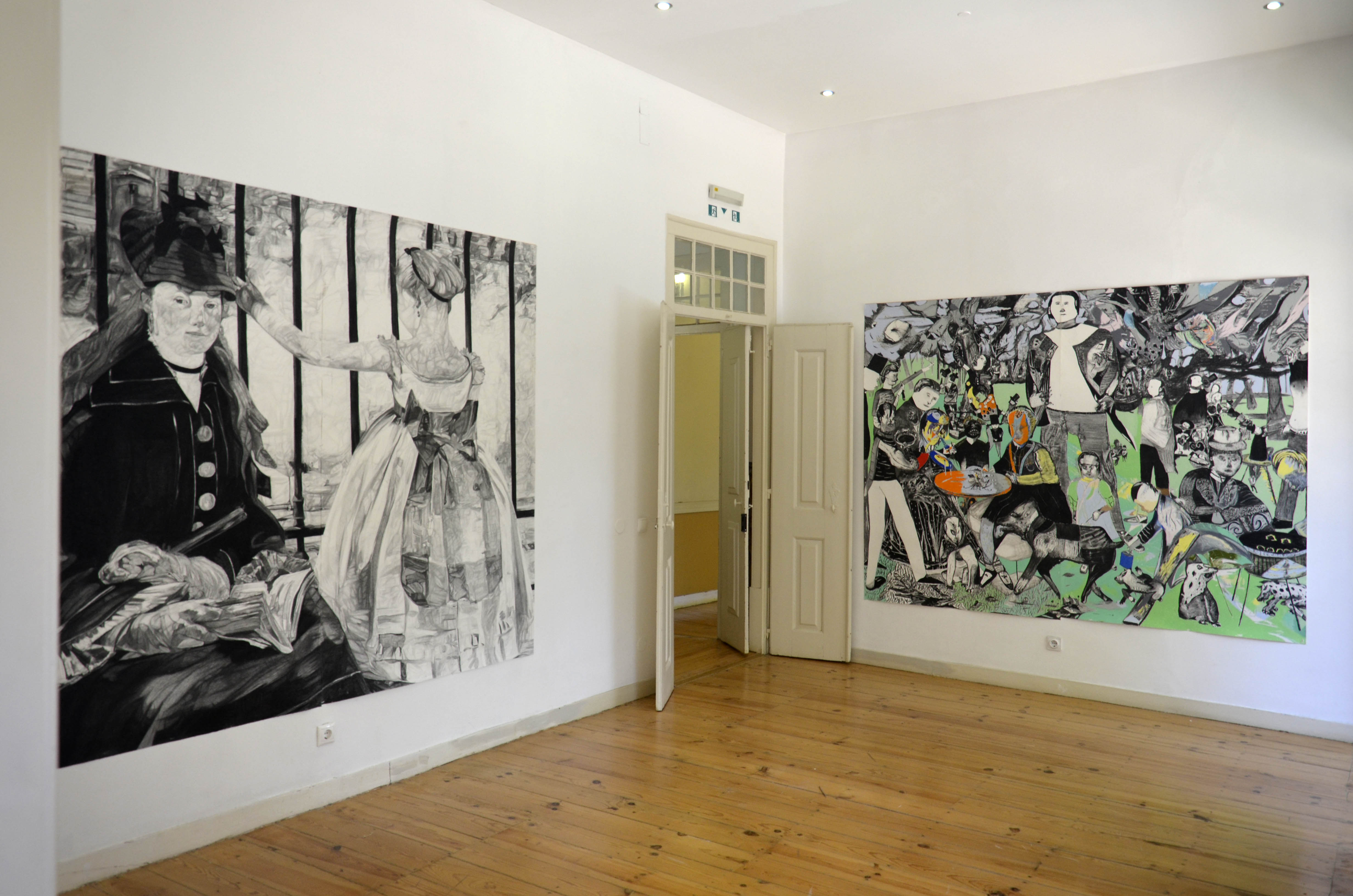
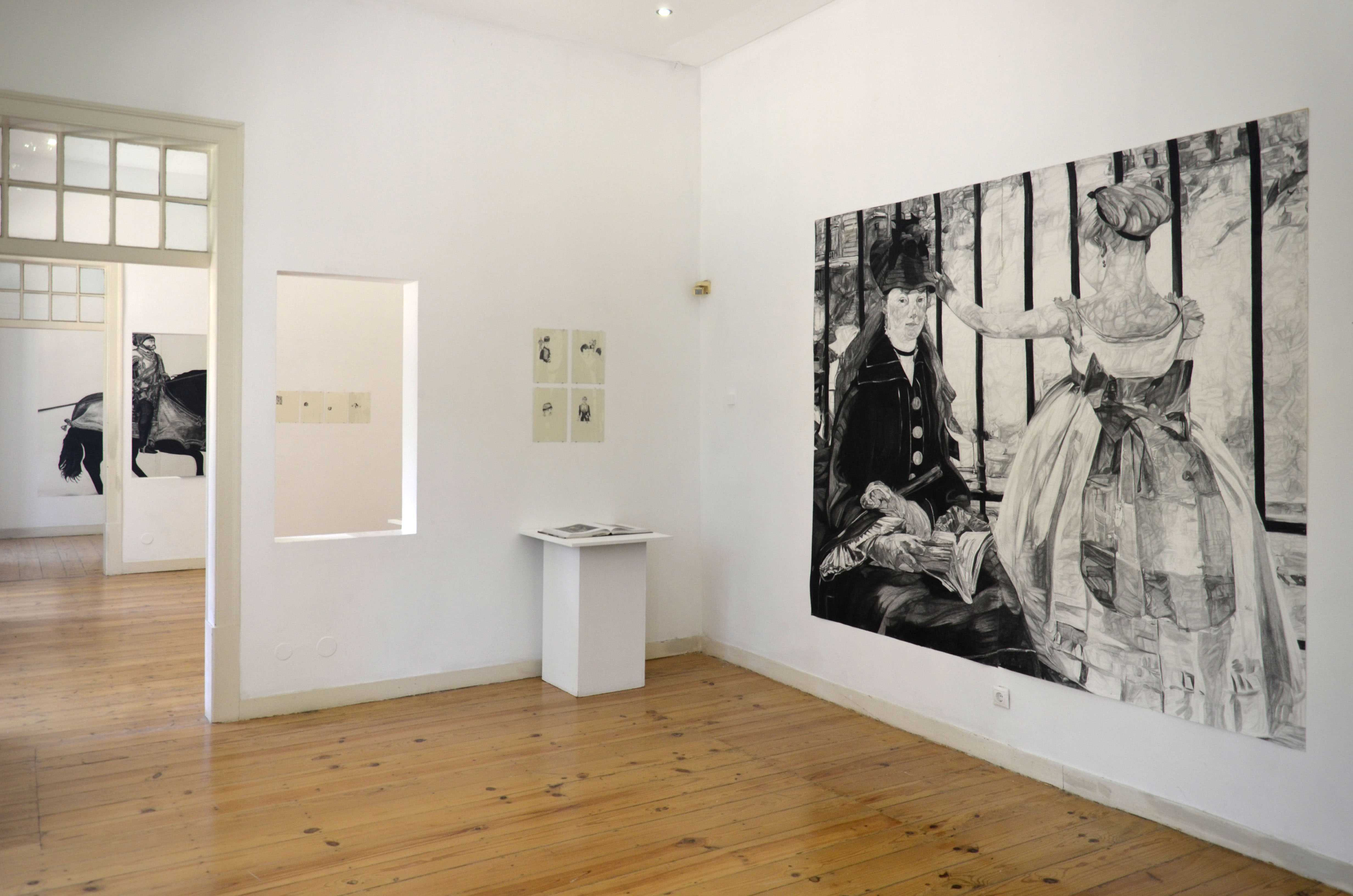
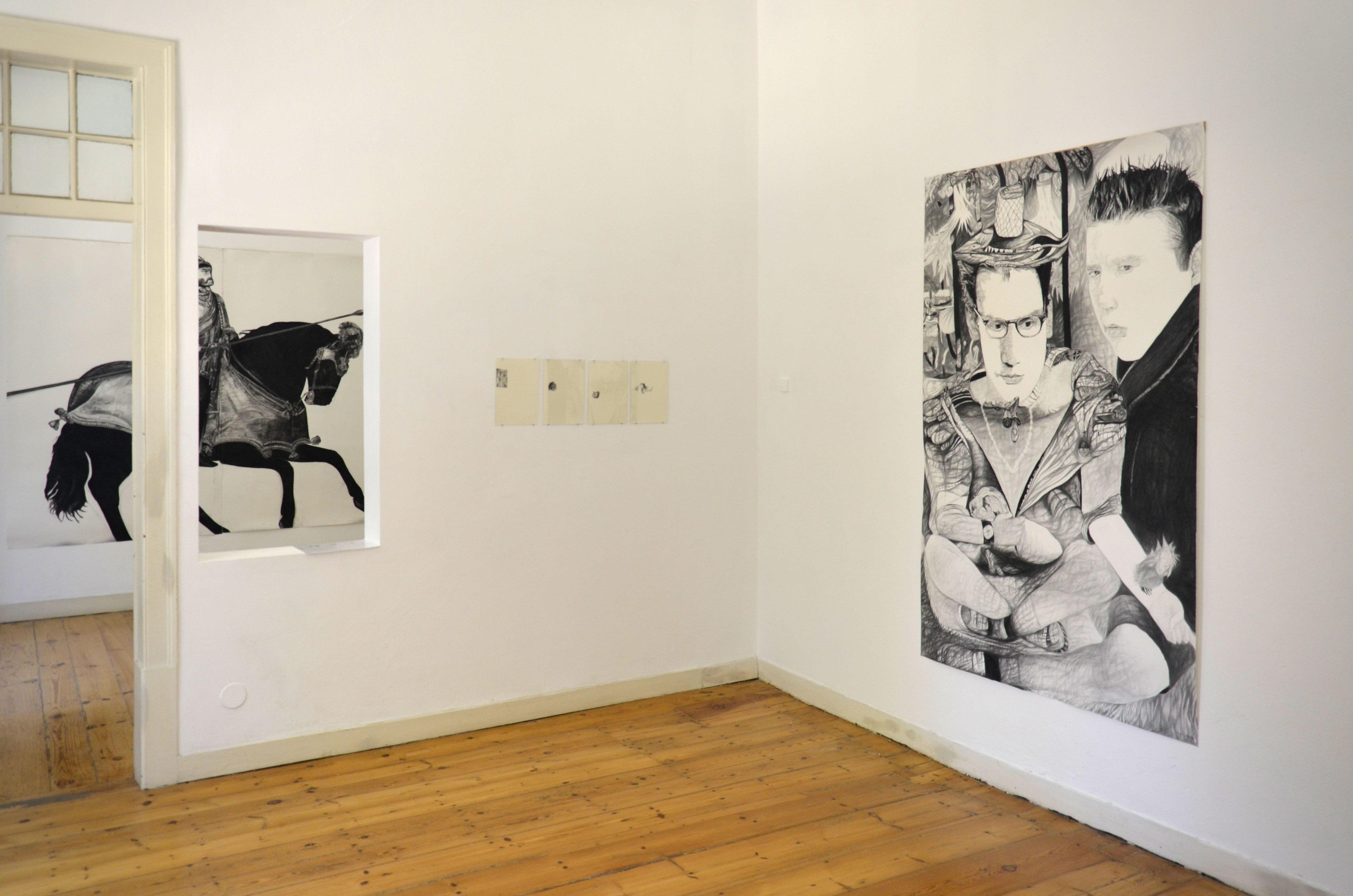


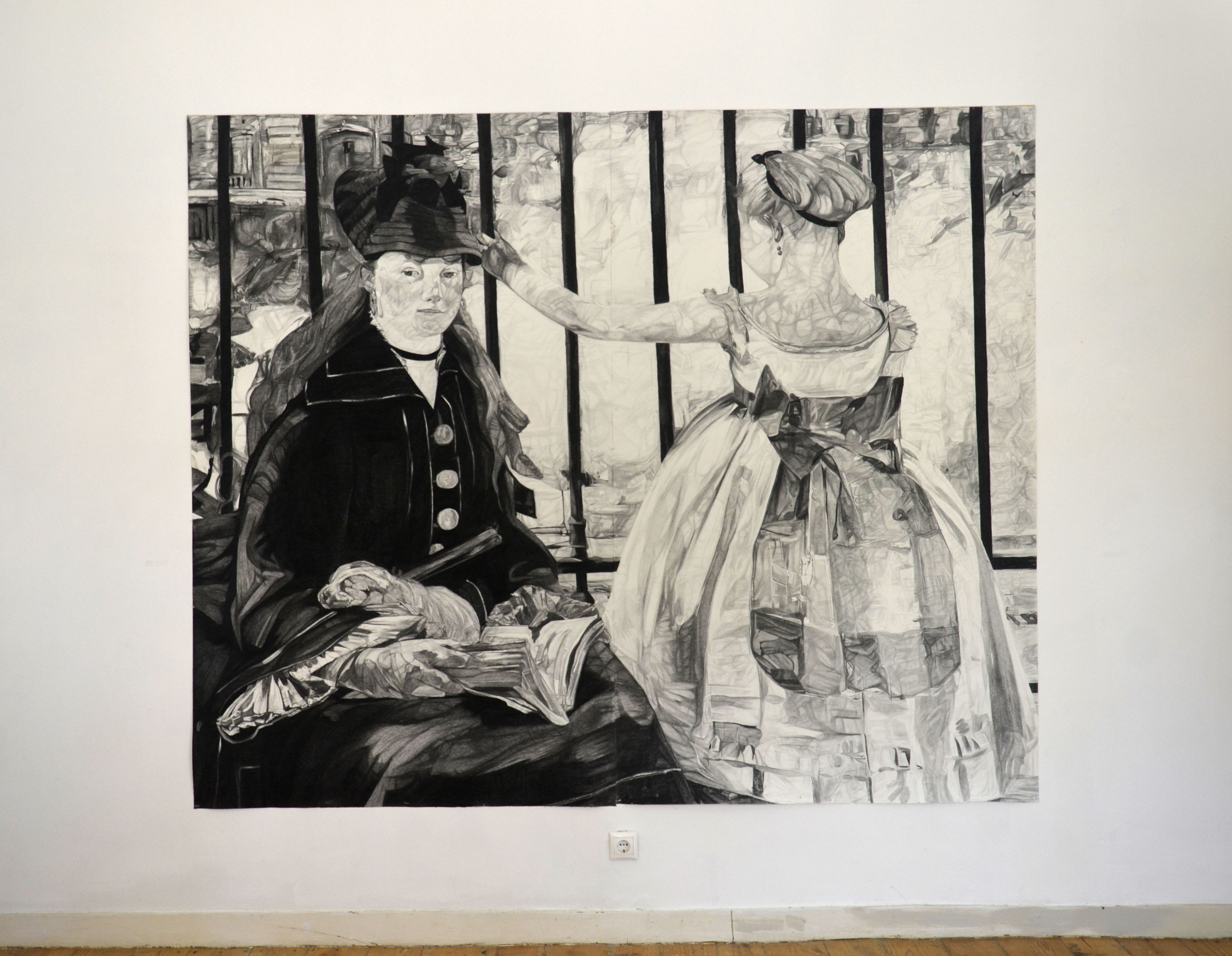
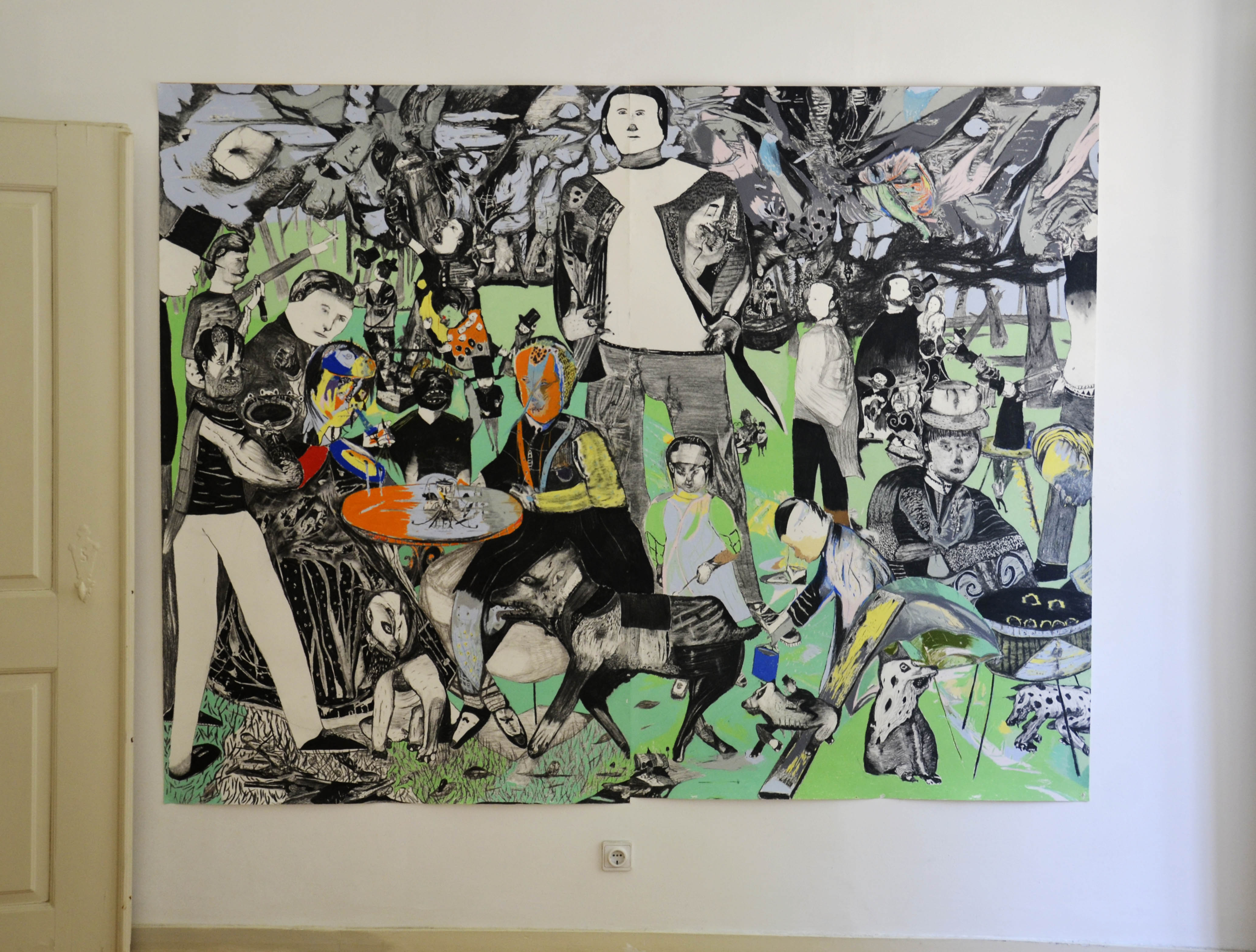


Titian’s Room
I chose Titian’s masterpiece, “Charles V at the Battle of Mühlberg,” for its chromatic richness and the interplay of light and shadow on the armor. I wanted to dissect this work to extract knowledge and techniques for my own future creations.
By analyzing the piece in detail, I was able to delve deeper into its textures and discover various nuances that aren't visible at a superficial glance. It was also an exercise in submission and total devotion to the original work.
I called this method "X-ray," as I felt I was analyzing the painting pixel by pixel, gaining a clearer understanding of all the details that make this work a true masterpiece.
My Brother’s Room
Wishing to distance myself from the Old Masters and from drawing based on a specific reference, I wanted to create a work with the same quality and technique but one that related directly to my own life.
“Irmãos” (Brothers) was initially inspired by two works: “The Burial of the Count of Orgaz” (El Greco, 1586) and “Gare Saint-Lazare” (Manet, 1873). Utilizing the background grid featured in Manet’s painting, I wanted to introduce several characters arranged in a row, as seen in El Greco’s work. I chose to use my own family members as the characters in this story.
Manet’s Room
Based on Manet’s work “Music in the Tuileries” (1862), I developed several pencil studies and a large-scale drawing in charcoal and pastel. In the studies, I attempted to faithfully reproduce parts of the composition that interested me. In the drawing “Manet’s Picnic,” I drew inspiration from the composition of “Music in the Tuileries,” which is divided into two planes: the lower plane, where various people dressed in finery engage in different actions (note the seated ladies listening to the music, the children playing in the dirt, or the gentleman removing his hat to greet someone...), and the upper plane, dominated by the foliage of the trees, leaving a small opening for the blue sky in the center of the painting.
I appropriated this theme and its composition to create my own vision. Replacing the opening of the blue sky, I introduced a figure that bridges the ground and the vegetation, dividing the space vertically in two. Reminiscences of top hats, period clothing, and chairs come directly from Manet’s work.
I chose “Gare Saint-Lazare” due to the contrast in the image. There is an older woman dressed in dark blue (likely the mother) and a young girl with her back to "us," wearing a light-colored ballerina dress (as if she were about to start her exercises). The title provides context: they are at a train station, subtly indicated by a cloud of steam from a passing train in the background. They are likely waiting for someone.
The luminous reflections on the girl’s dress appealed to me so much that this entire image was created to capture its magnificent details and lighting effects
Luís Almeida
“Strange Days”
Solo Exhibition
Quase Galeria, Espaço T
Porto, 2022
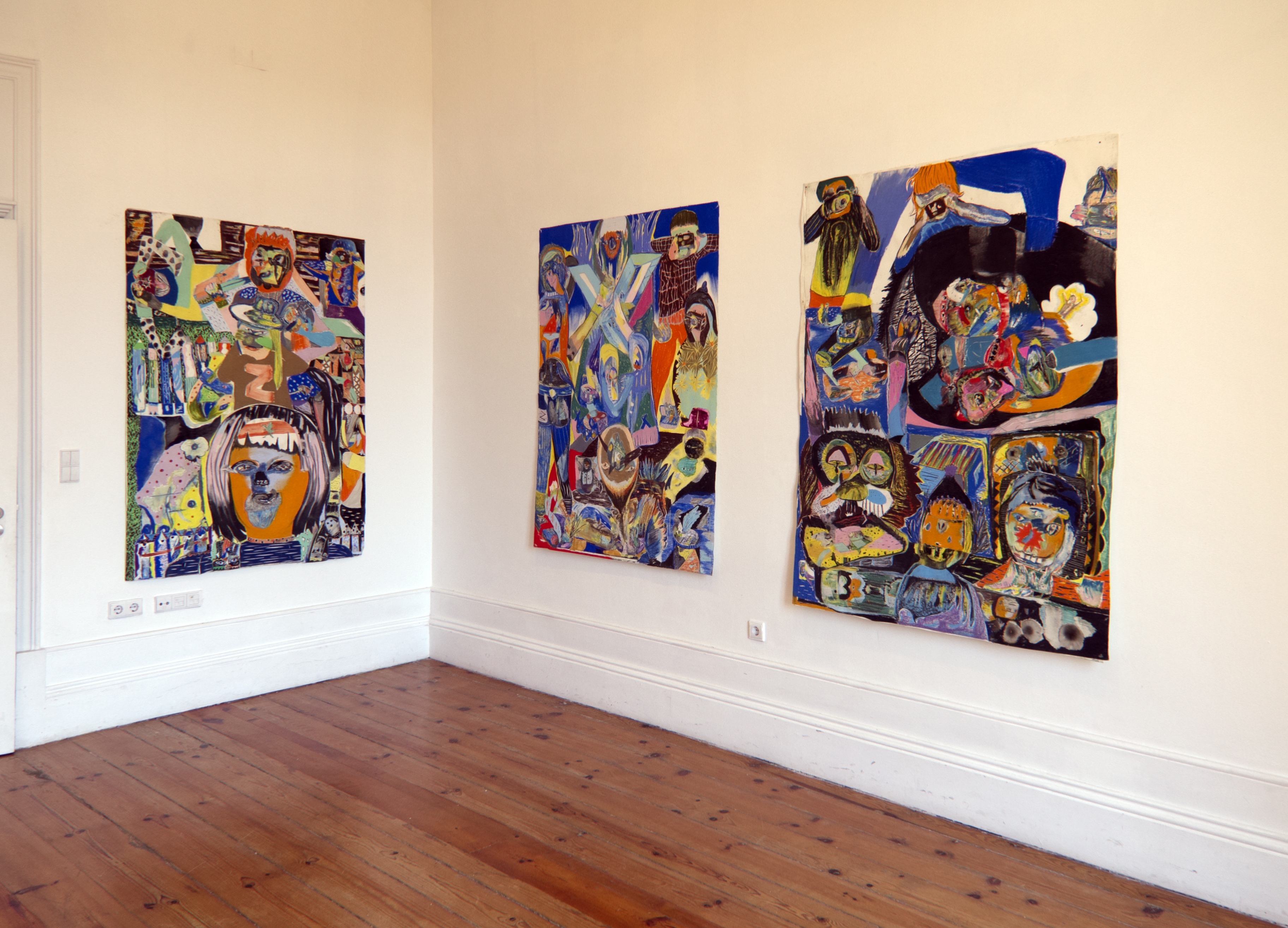
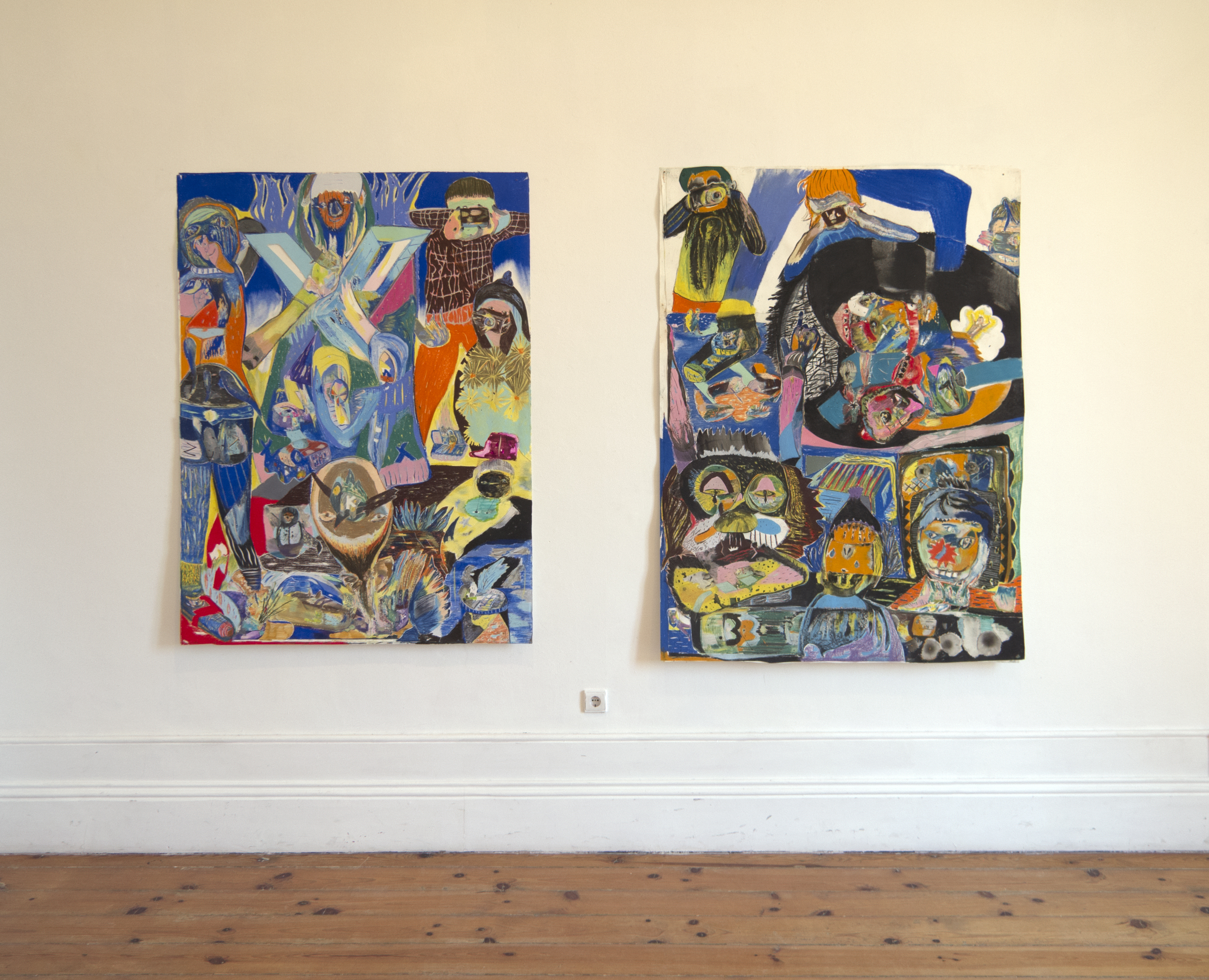
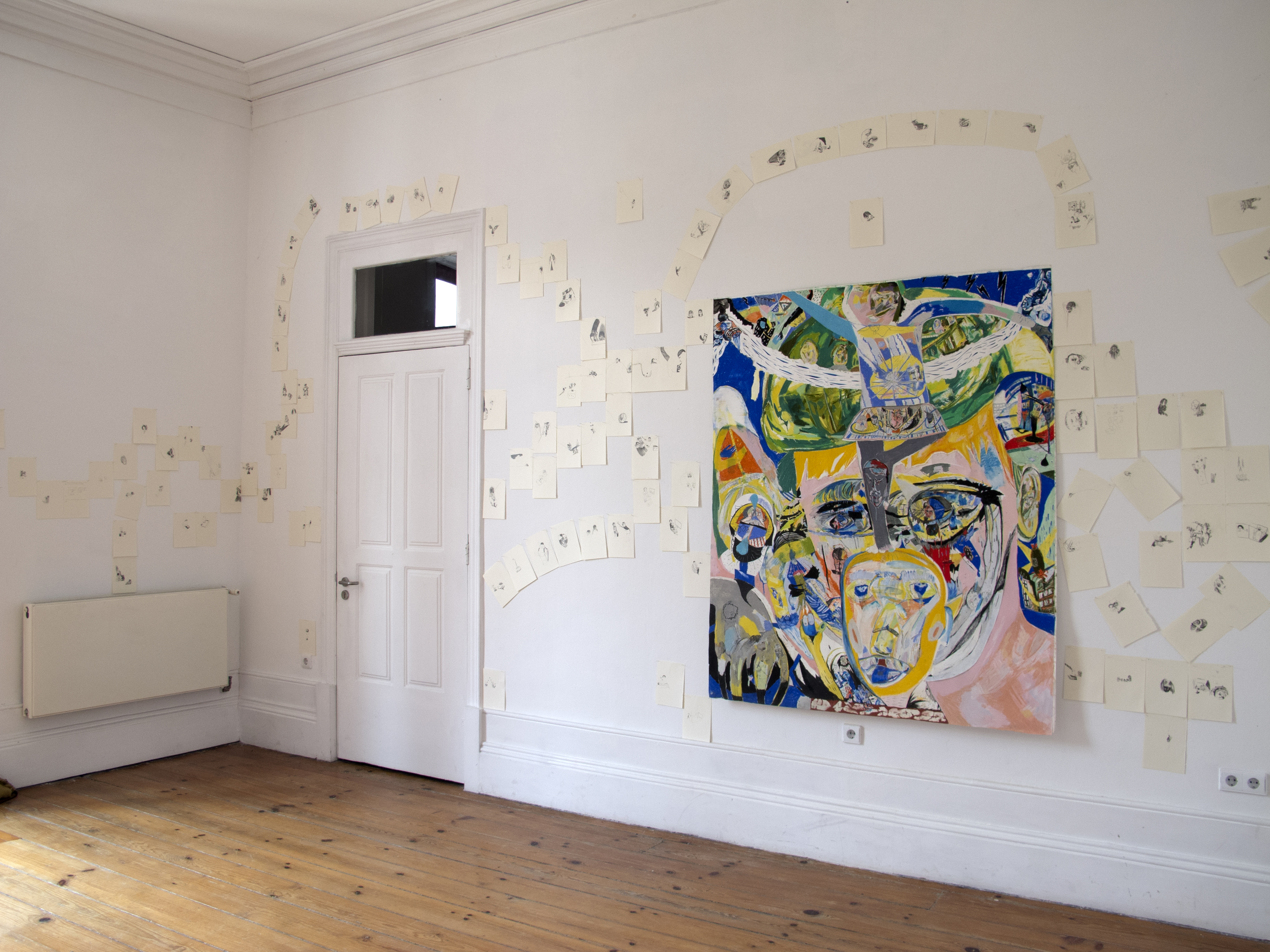
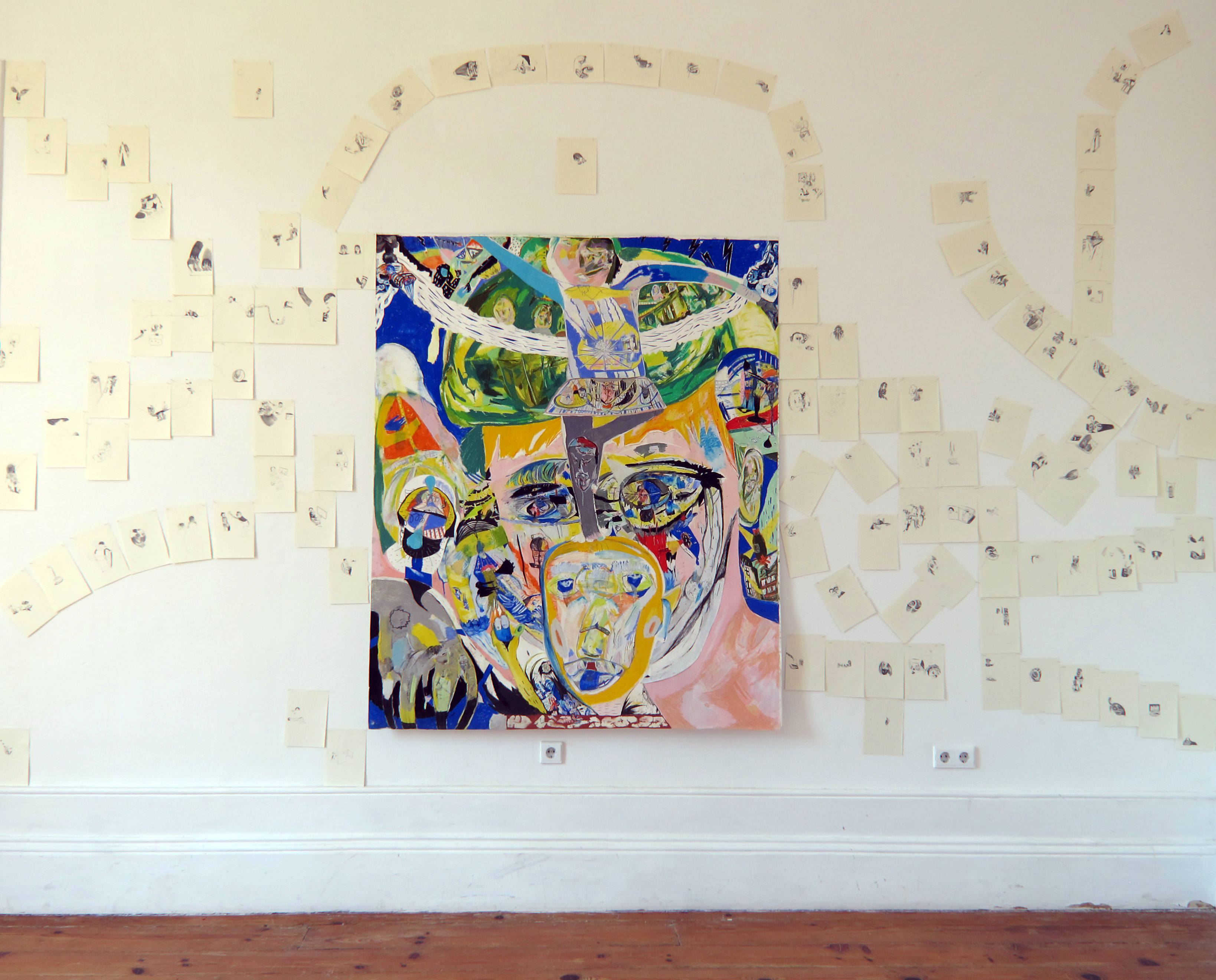
Curated by Maria de Fátima Lambert
“1”
Collective
O Gabinete de Madame Thao
Lisbon, 2022
Wall drawing
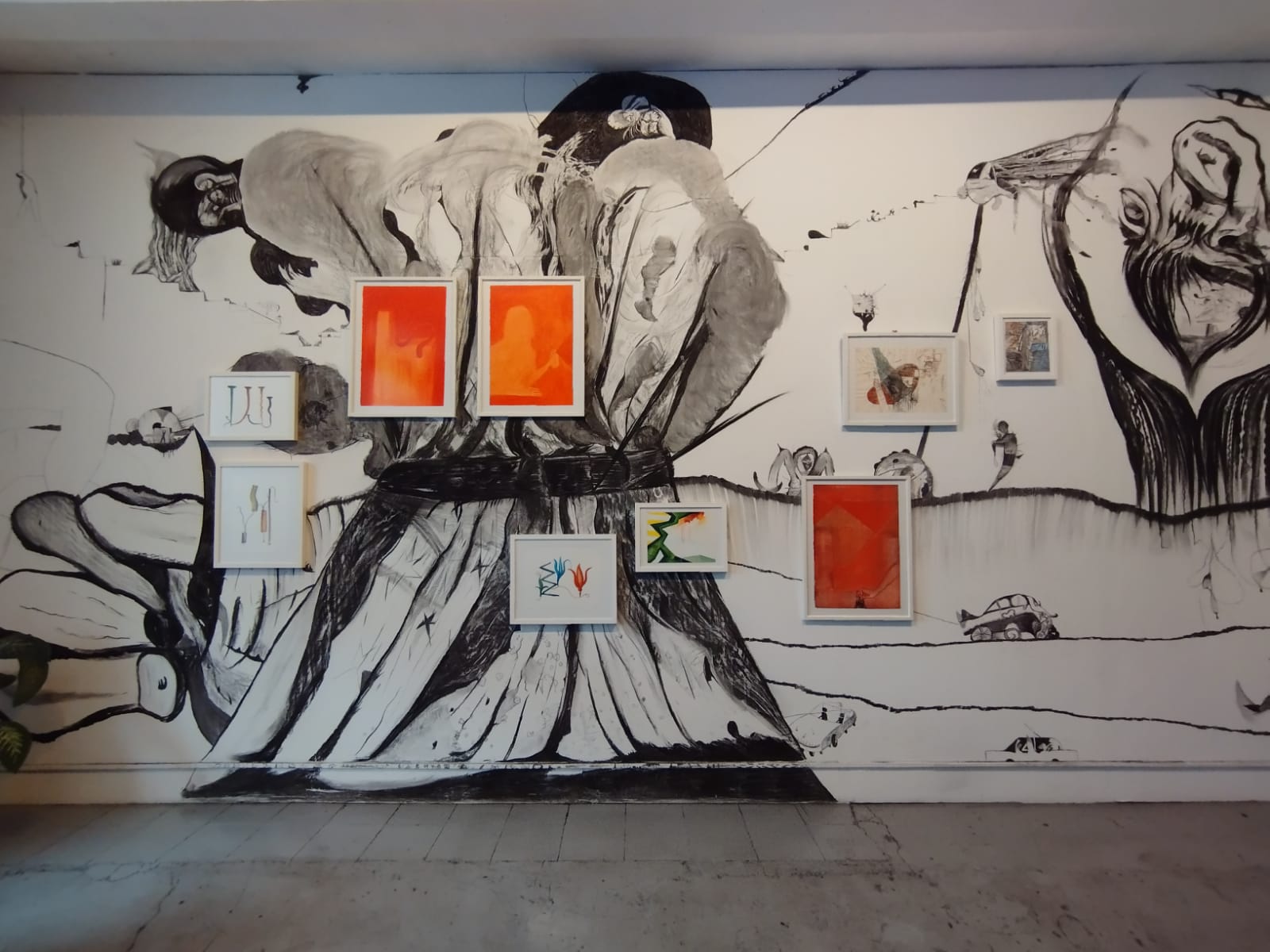
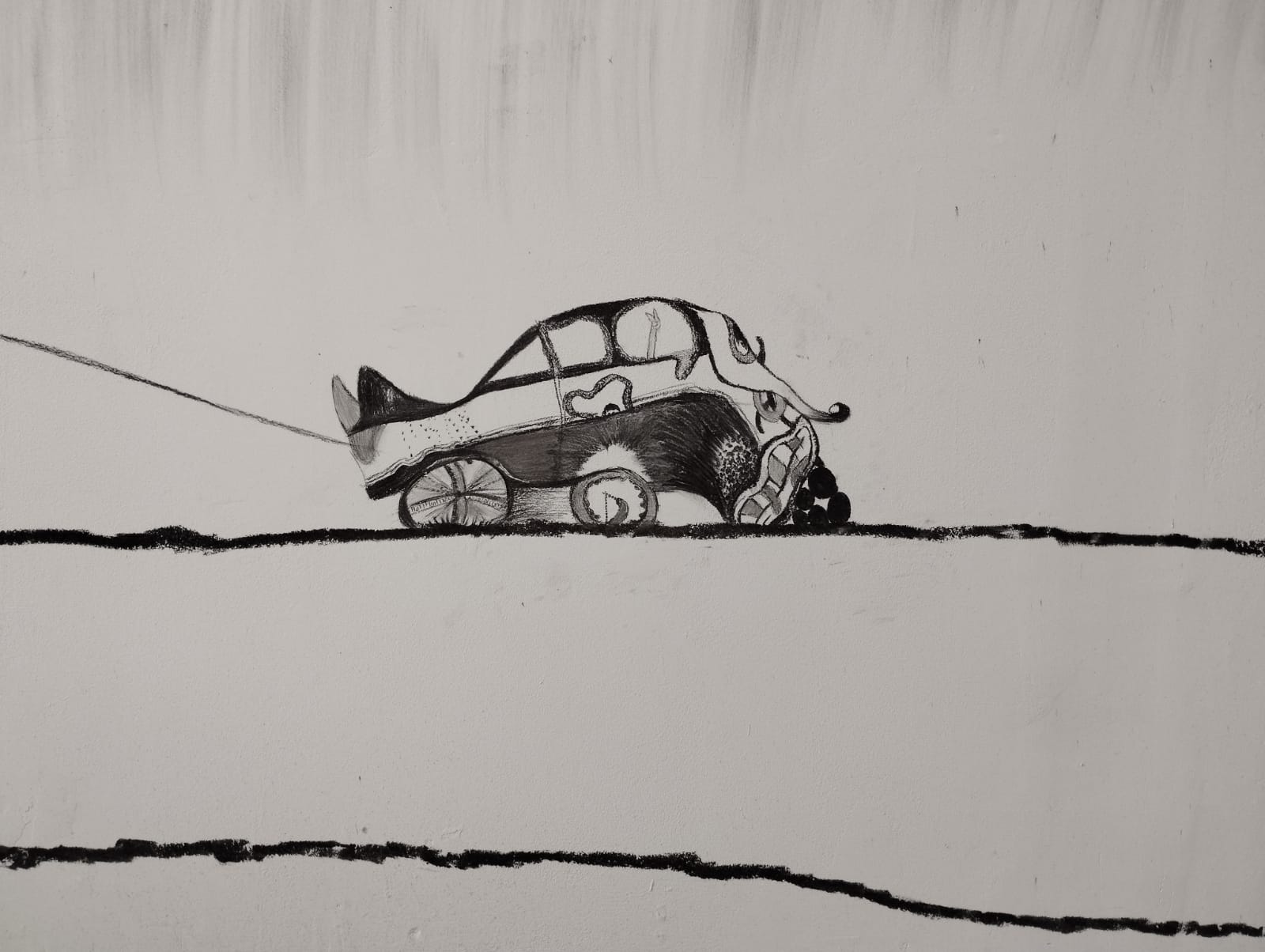
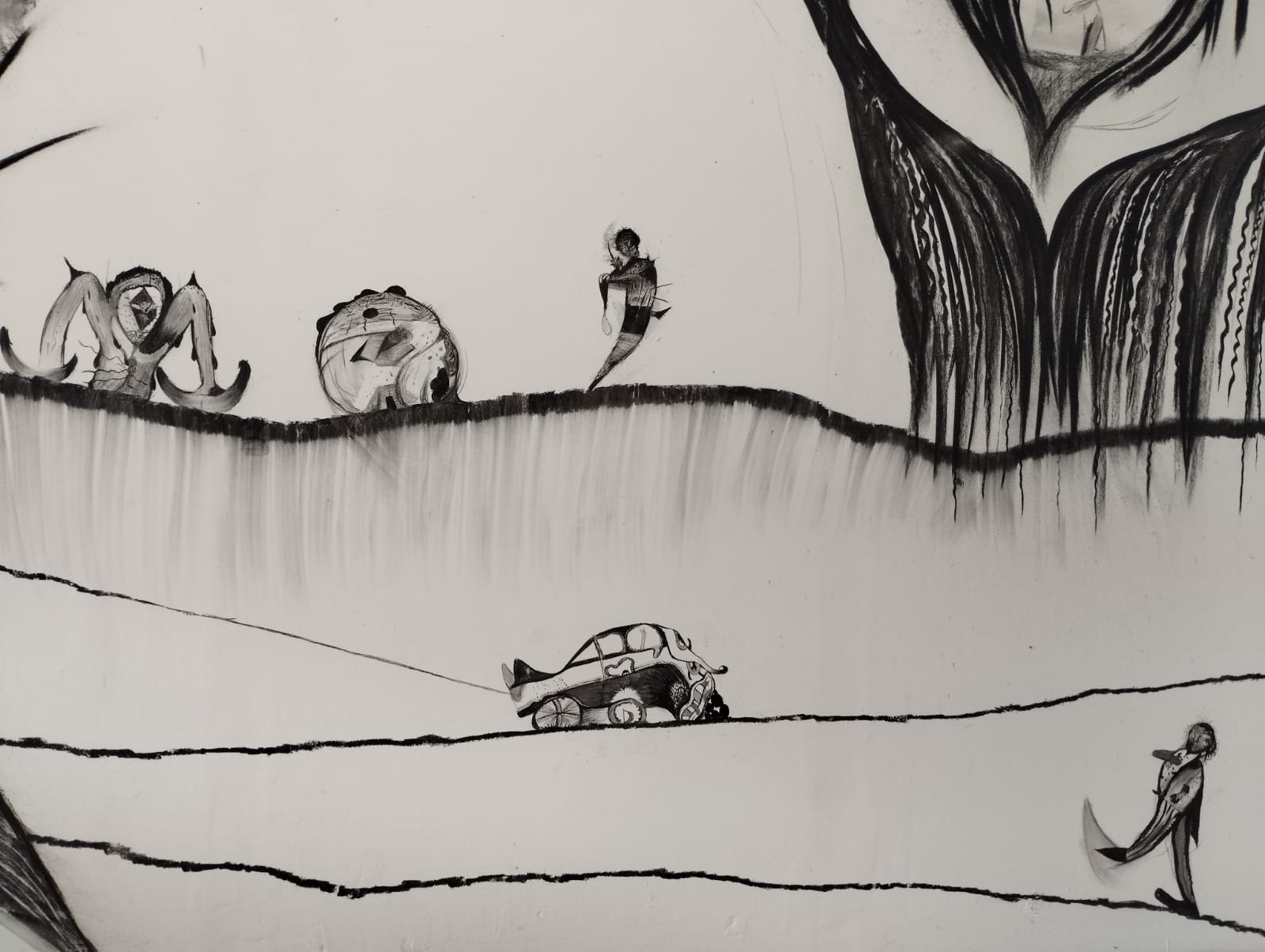
Curated by Sandrine Llouquet
“Various Positions”
With Rodrigo Canhão, Luís Silveirinha and Run Jiang
BAG - Banco das Artes Galeria
Leiria, 2022
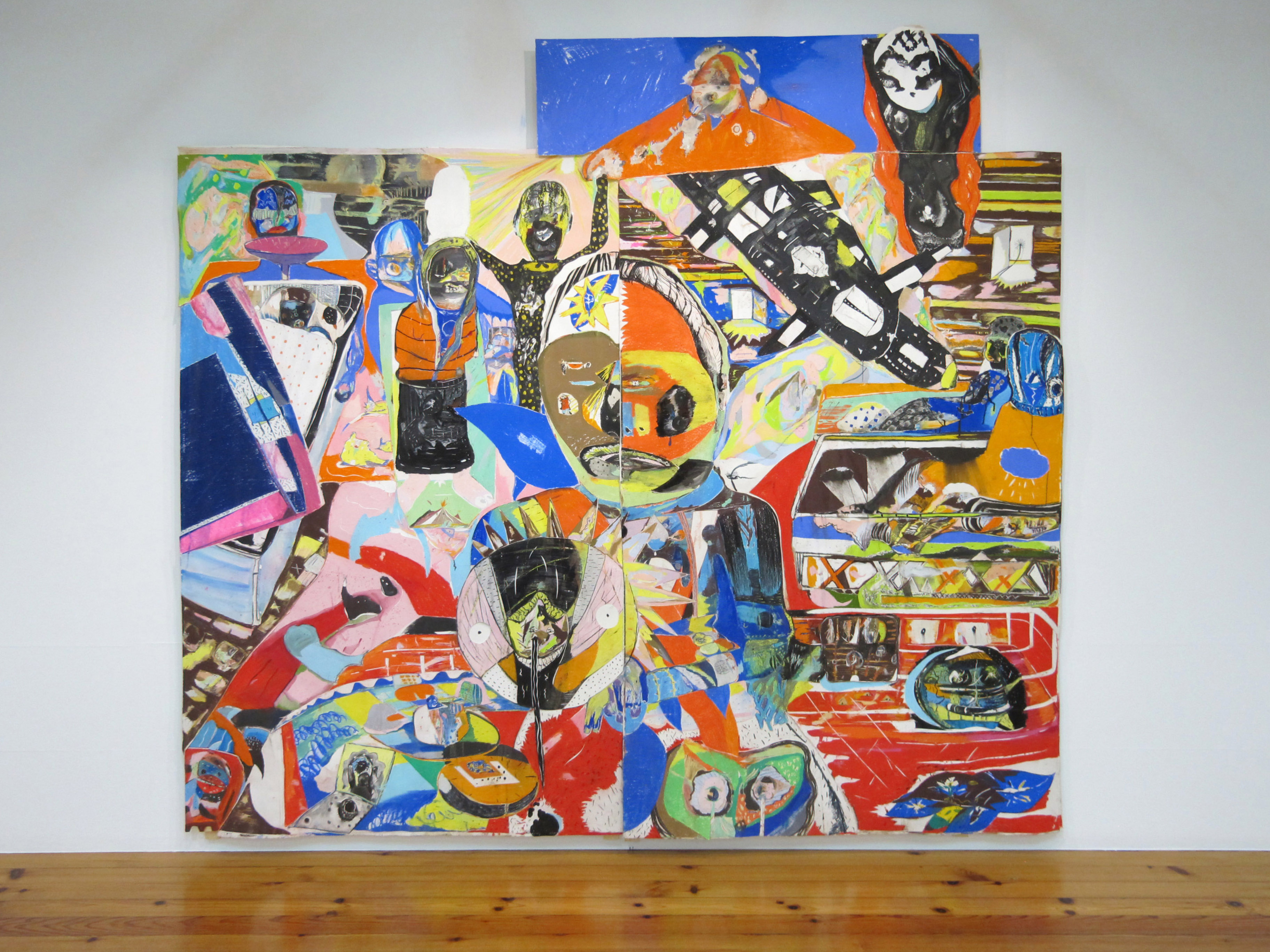

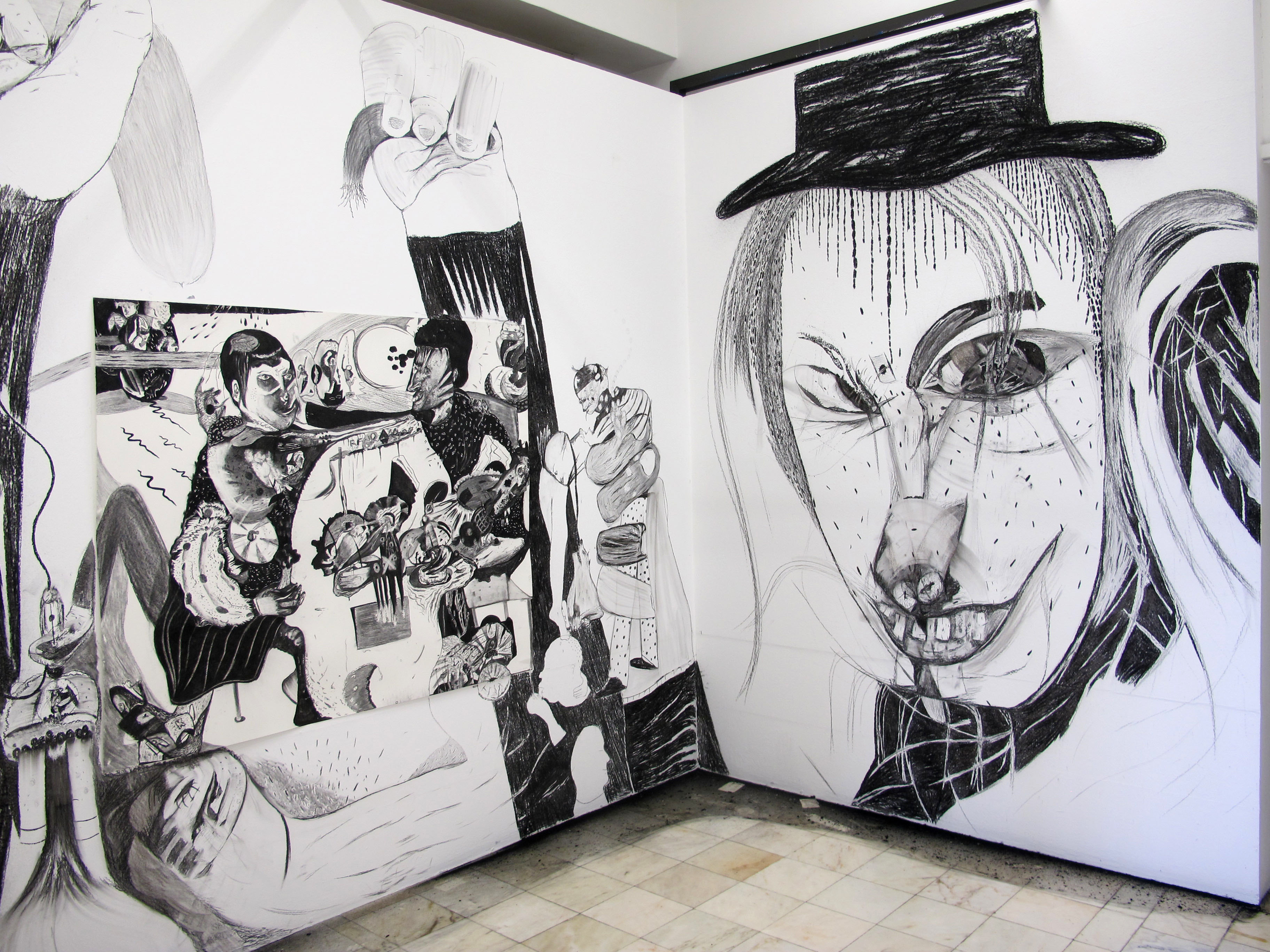
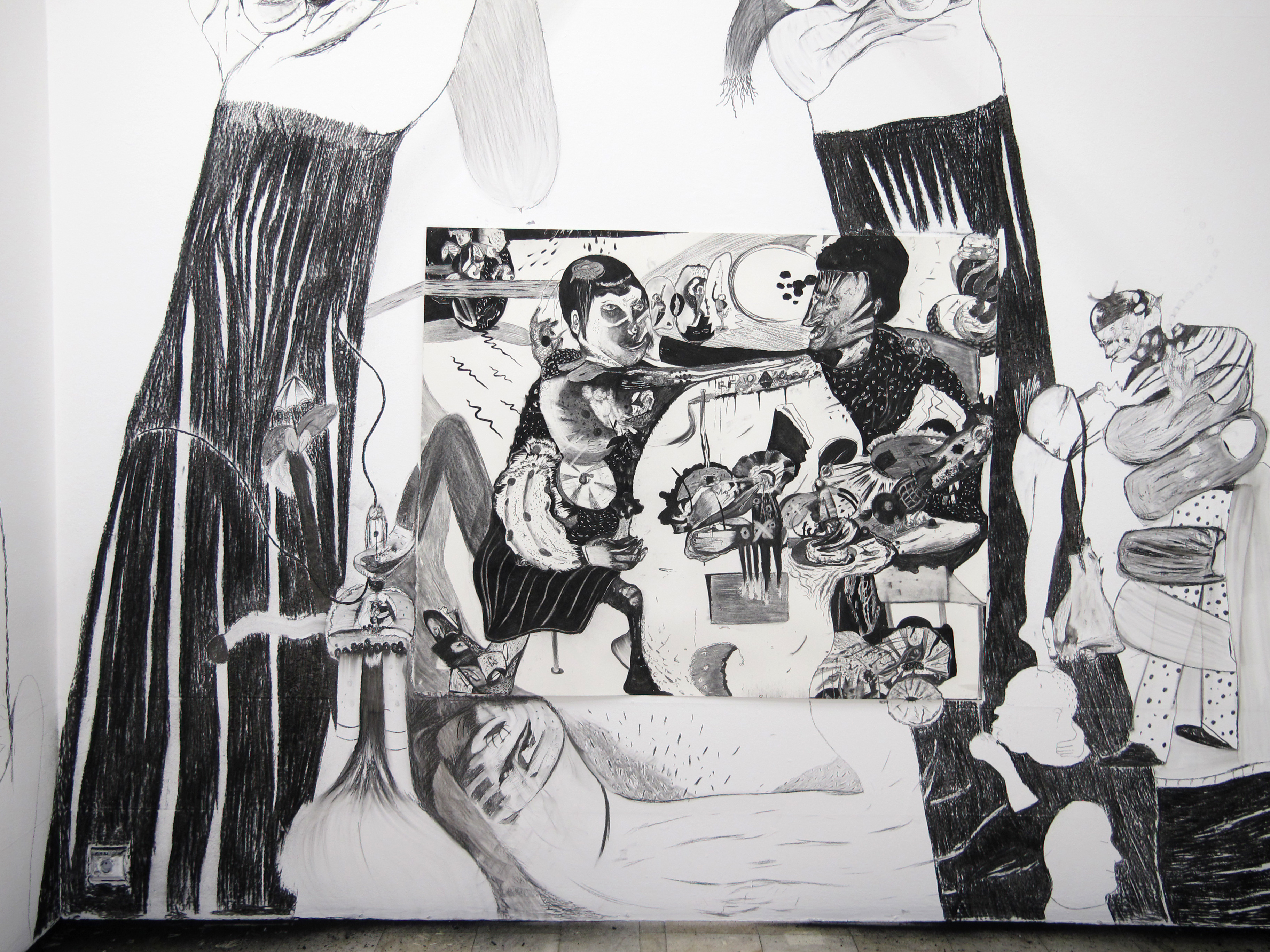
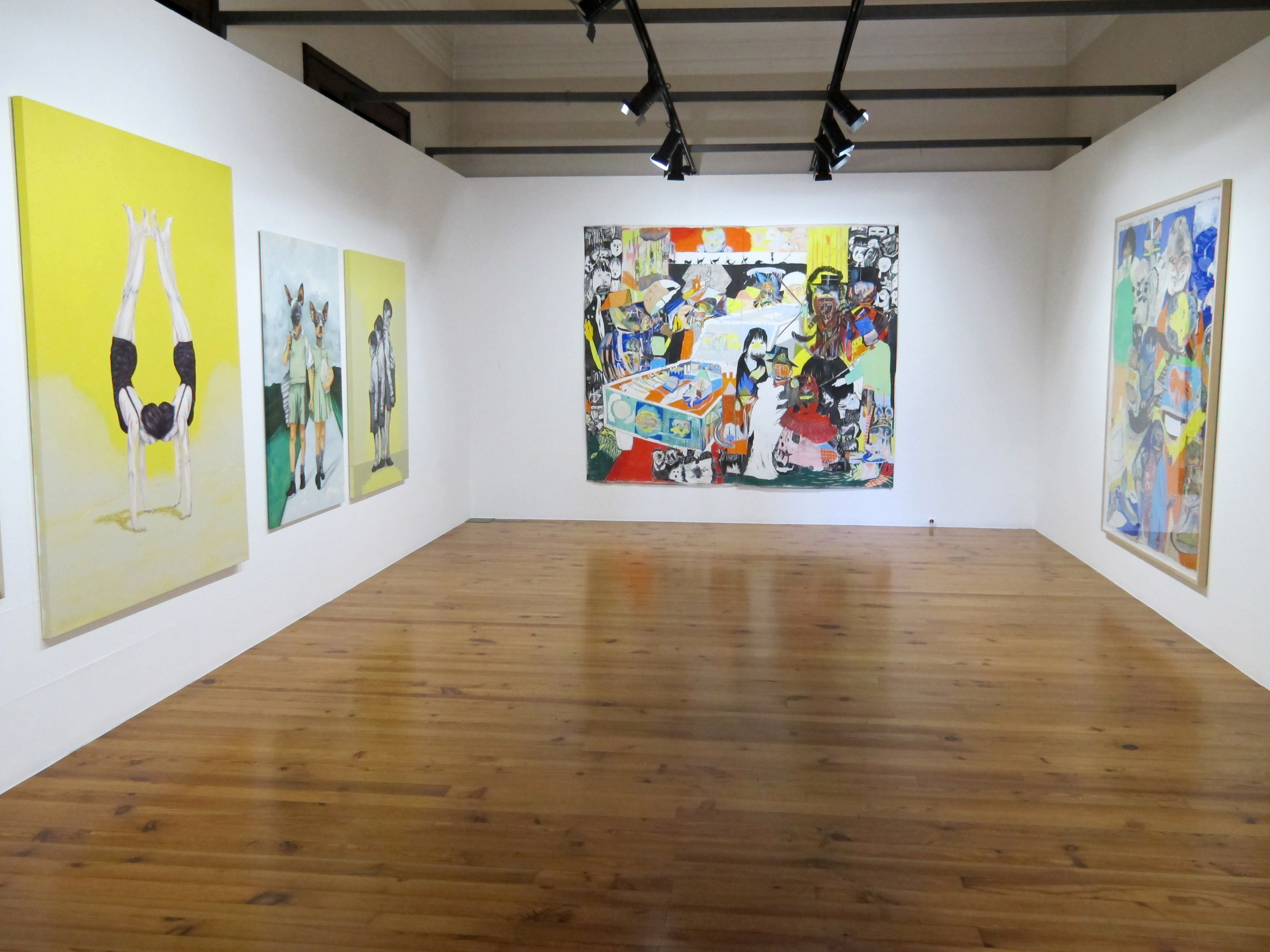
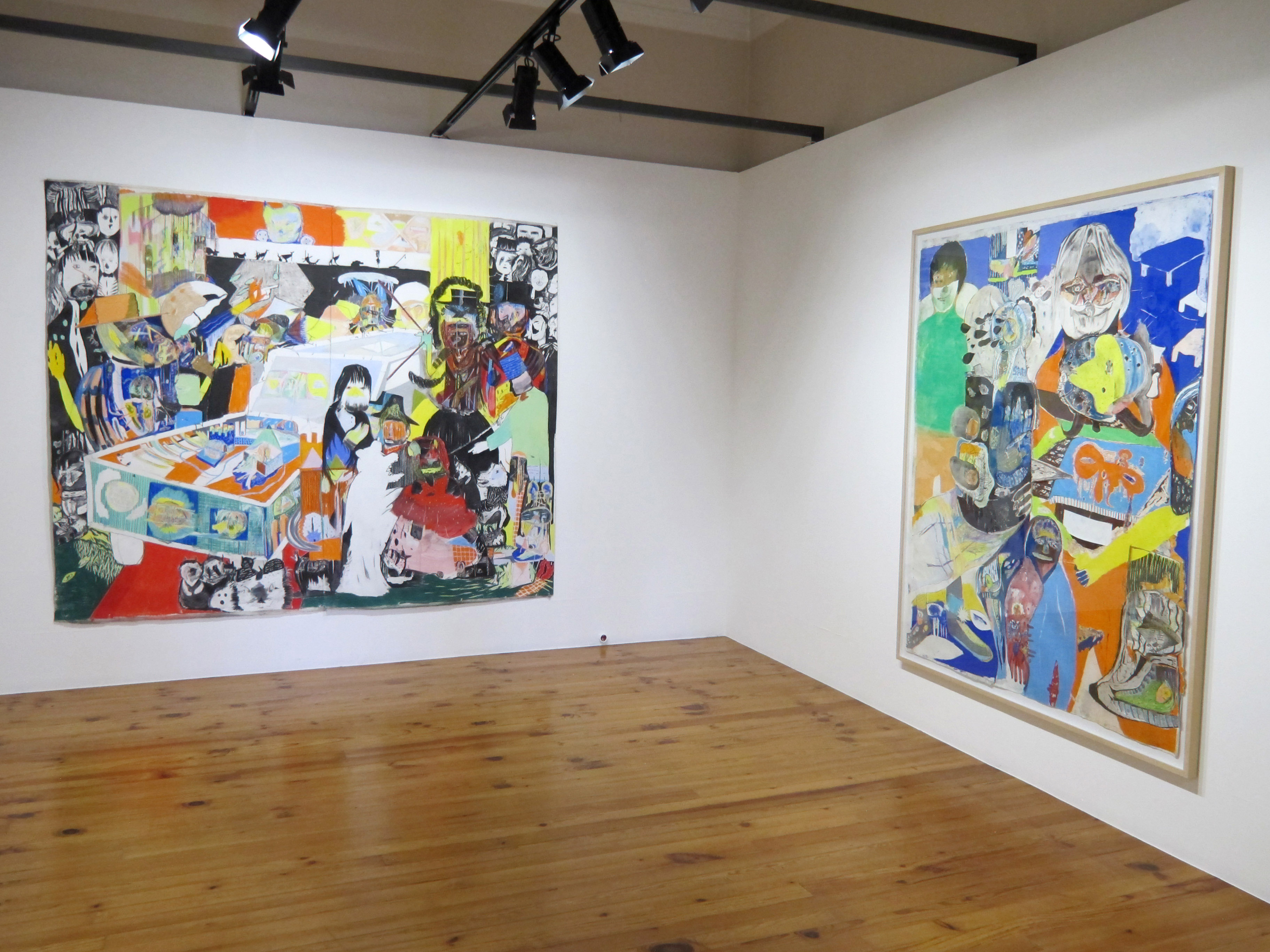
Curated by Ana David Mendes
“Whose Masks”
With Rodrigo Canhão and Run Jiang
Centro Cultural - Quinta Magnólia
Funchal, 2021

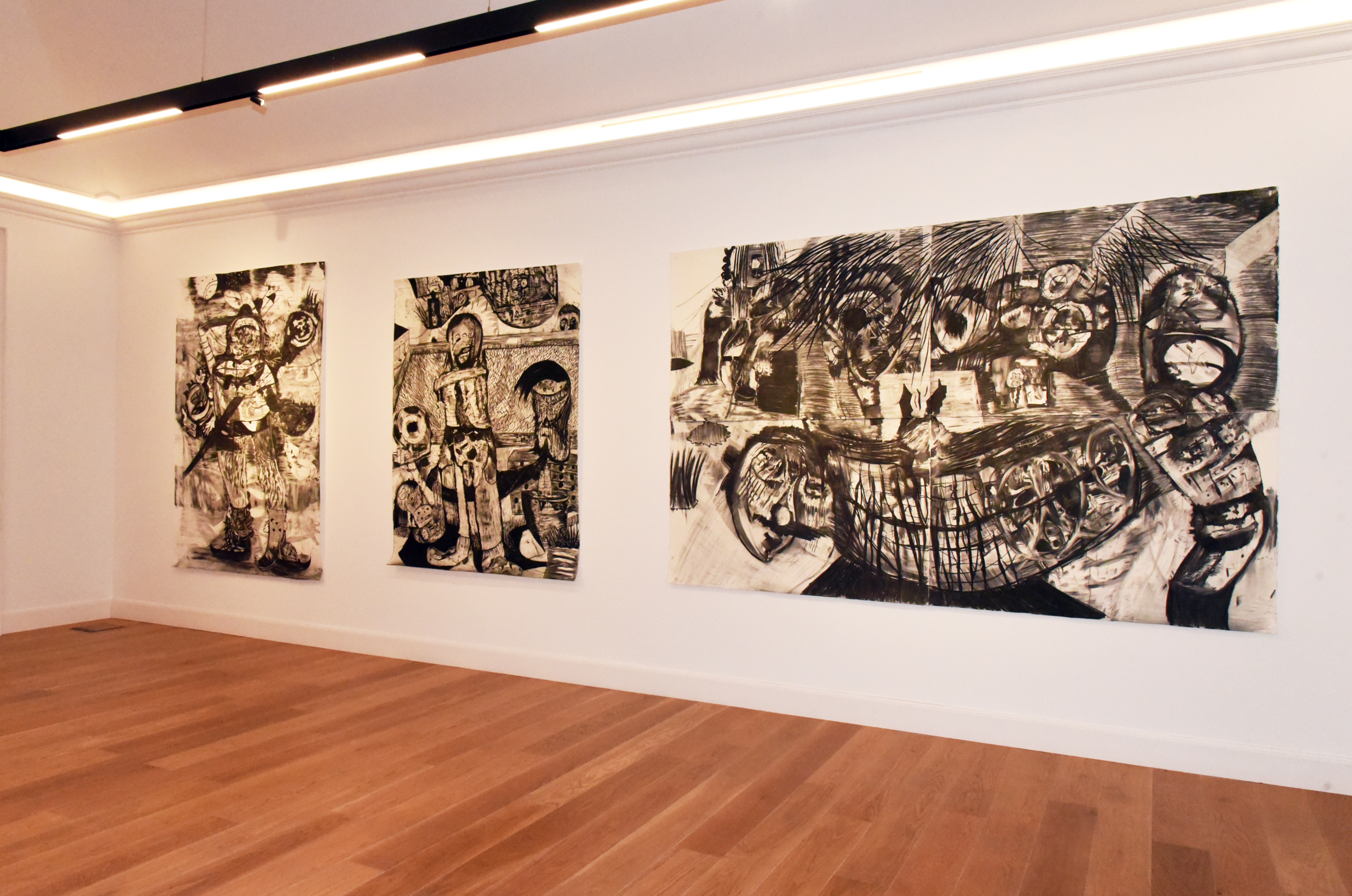
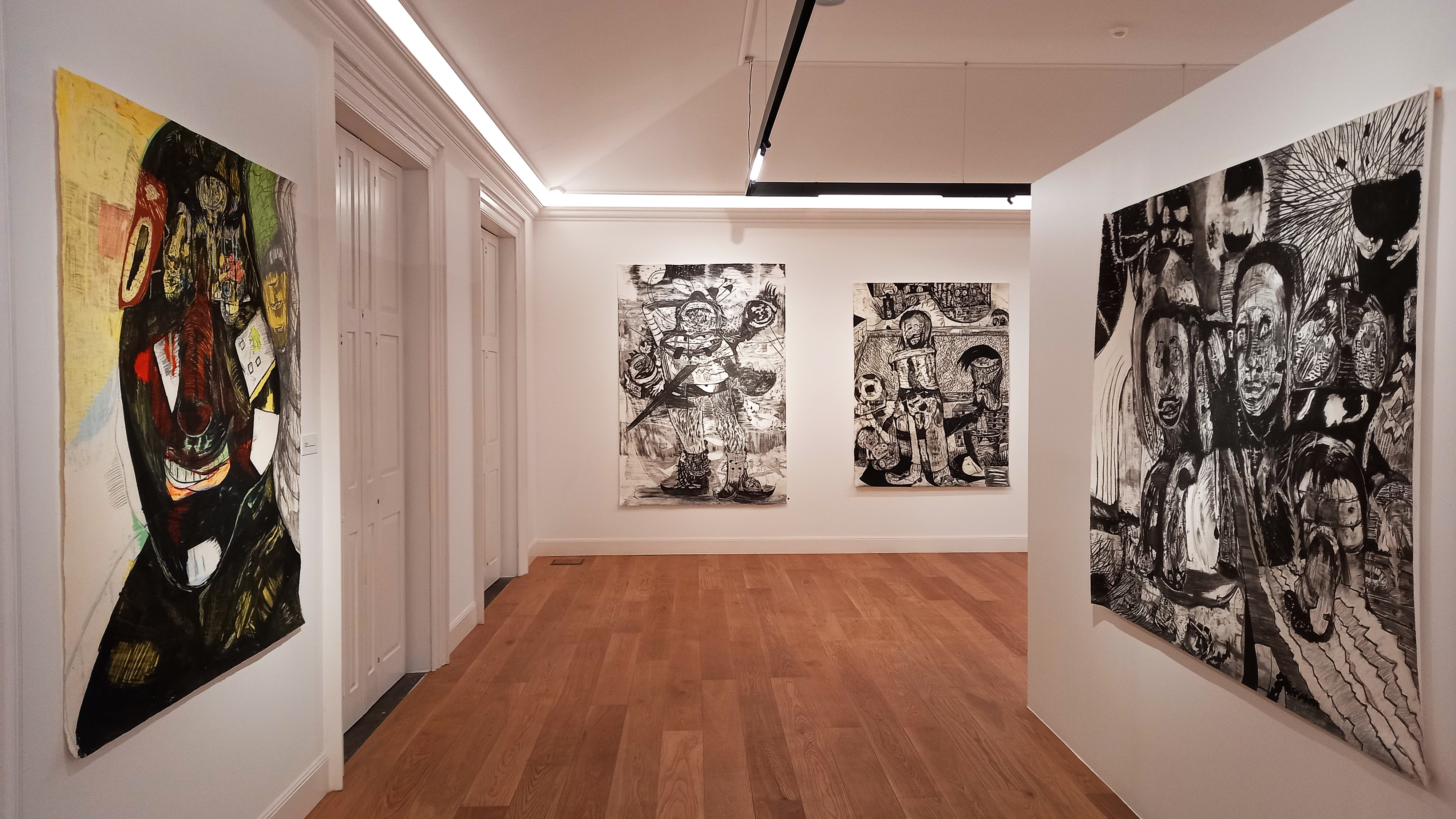

“Playing with Fire”
Solo Exhibition
Gallery Alecrim 50
Lisbon, 2018

“Não, Obrigada”
With Run Jiang
Espaço AZ
Lisbon, 2017
![]()
![]()
![]()
![]()
![]()
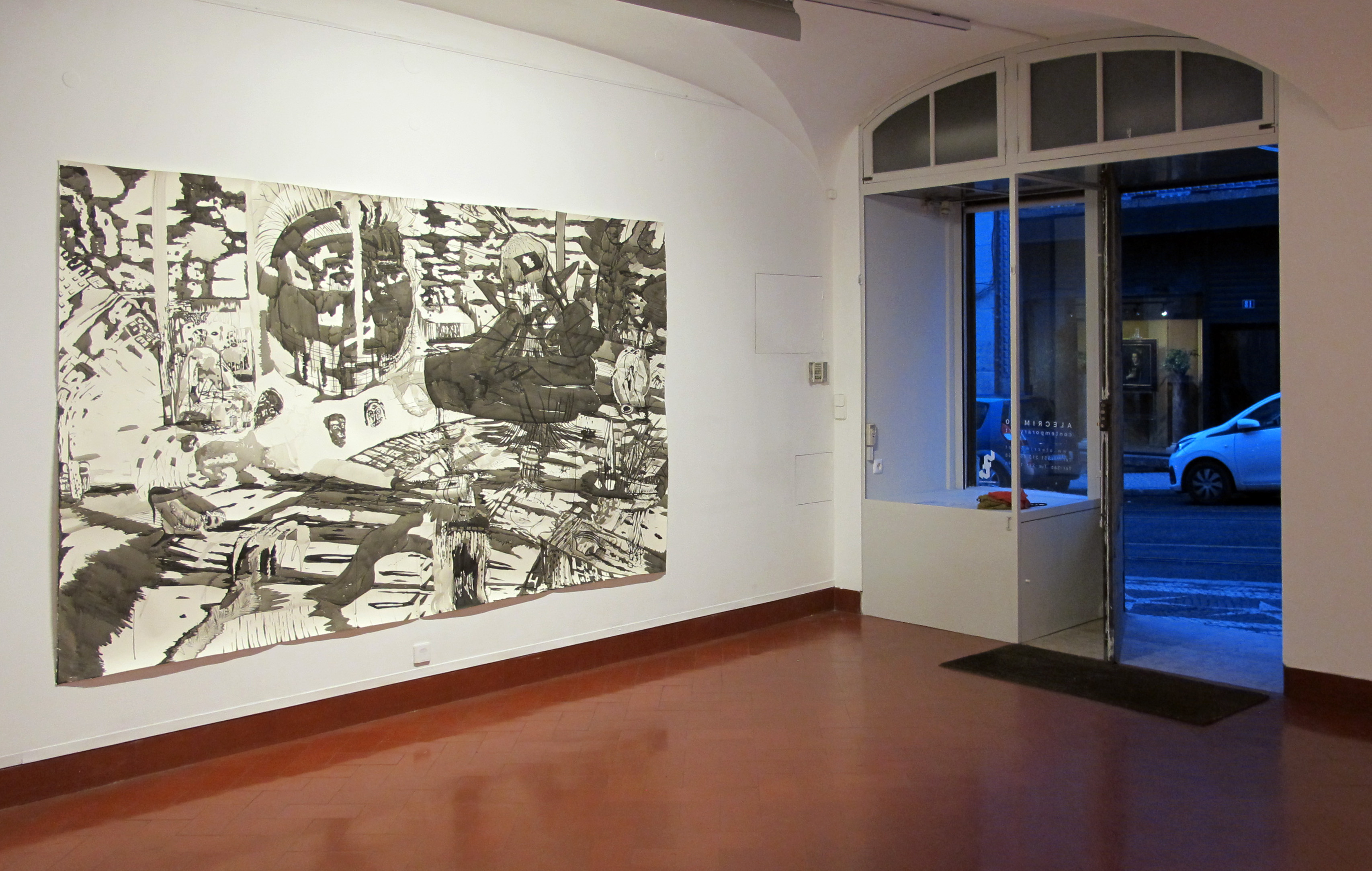
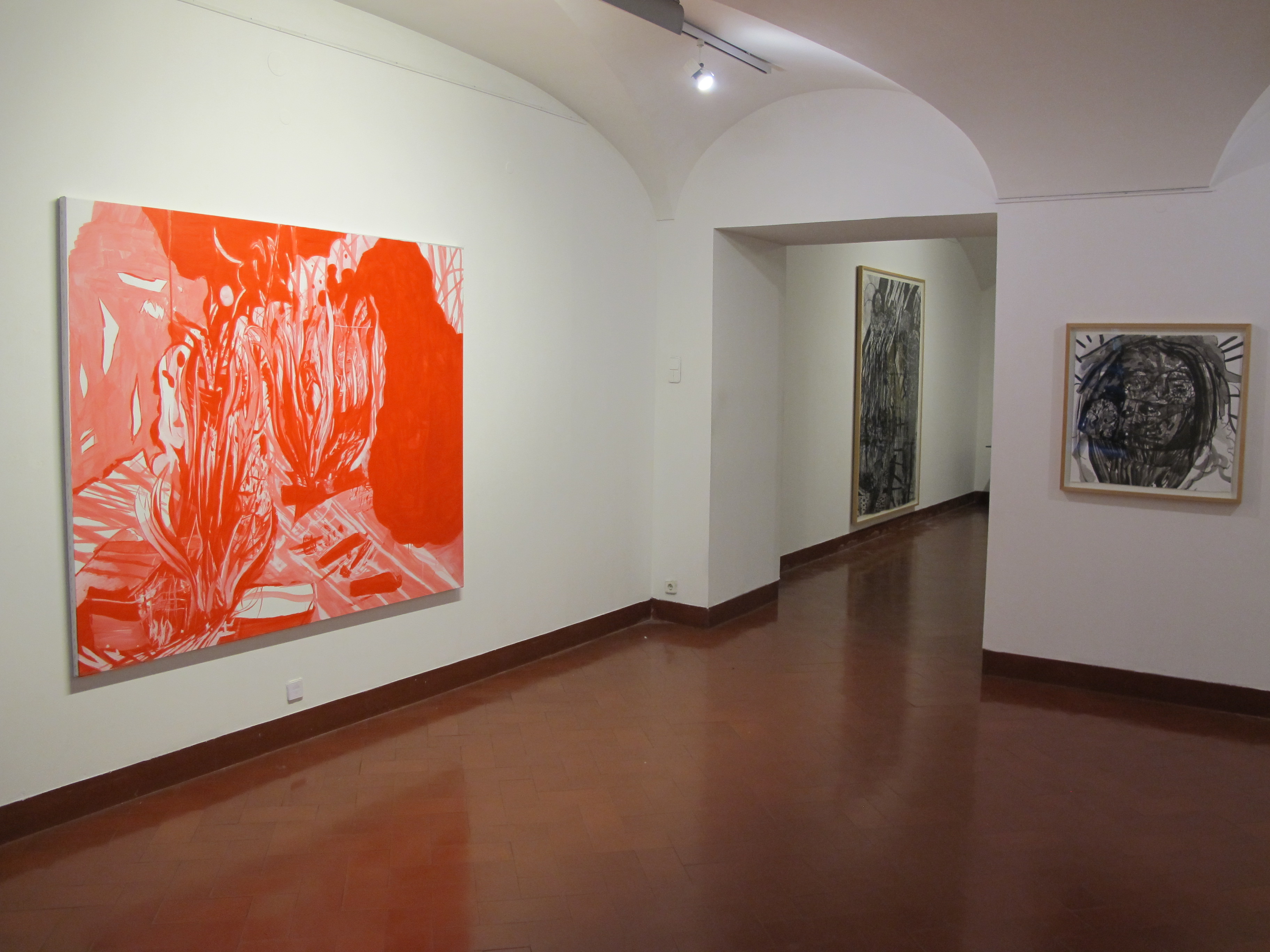
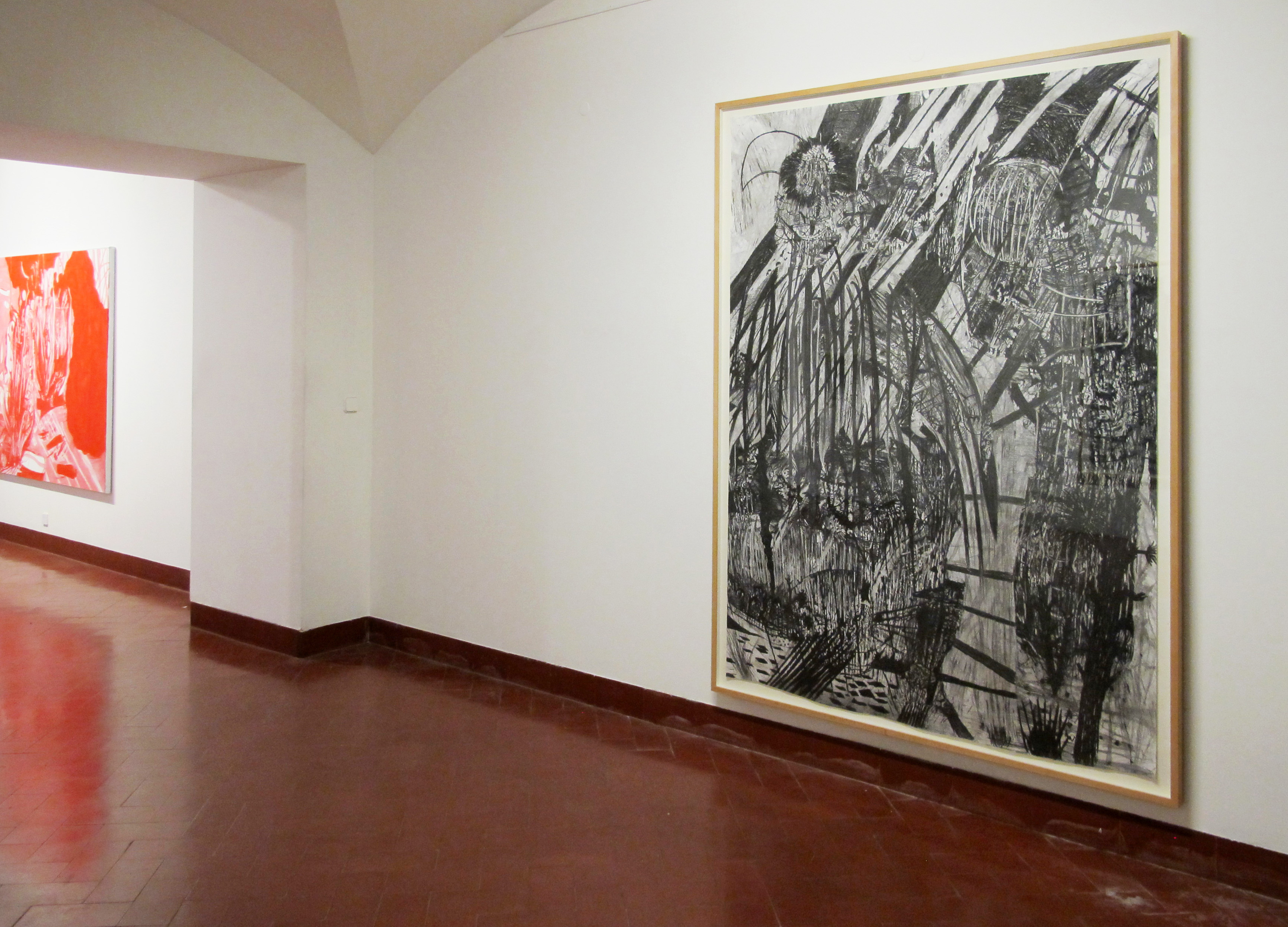
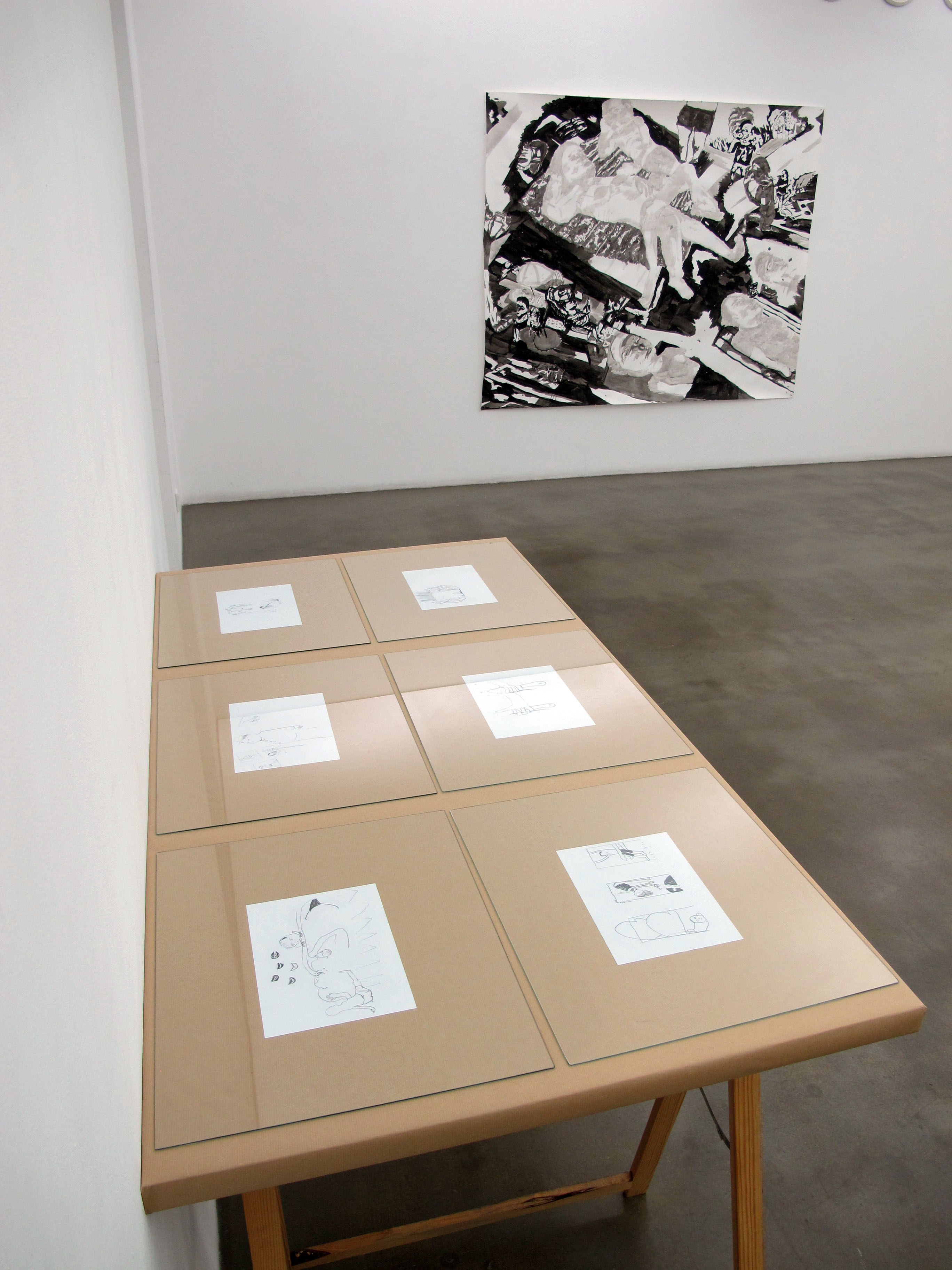
In these drawings, always in black and white (consistent with his painting thus far, where the use of bright colors primarily signals a permanent construction of chiaroscuro compositions), Luís flings himself frenetically into the creation of a complex network of multiple planes, humorously displaying the foundations of improbable and flamboyant architectures.
“Marriage”
Duo Exhibition
Cultural Center Emmerico Nunes
Sines, 2017
![]()
![]()
![Wall drawing Luís Almeida Run Jiang]()
![]()
![]()
![]()
“Santa Fé”
Solo exhibition
Studio Pilote
Paris, 2016
![]()
![]()
![]()
“O Paraíso não é por aí...”
Solo exhibition
Gallery Alecrim 50
Lisbon, 2016
![]()
![]()
![]()
![Alecrim 50 galeria]()
![]()
“66e édition Jeune Création”


Curated by André Almeida e Sousa
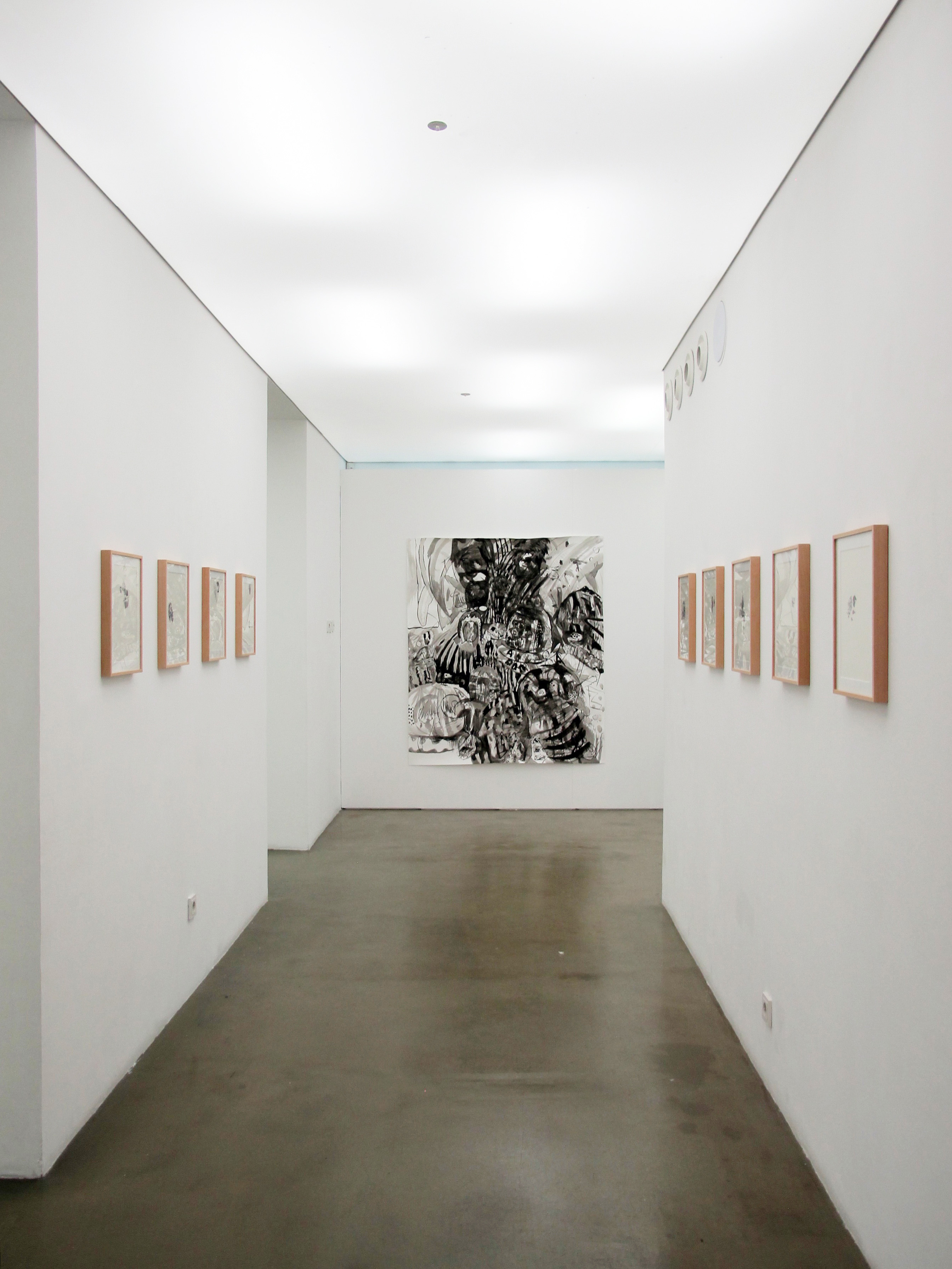
In these drawings, always in black and white (consistent with his painting thus far, where the use of bright colors primarily signals a permanent construction of chiaroscuro compositions), Luís flings himself frenetically into the creation of a complex network of multiple planes, humorously displaying the foundations of improbable and flamboyant architectures.
On the larger scales, gestures of conquest and usurpation overlap with the visible world. In these, one senses a veiled invocation of historical paintings—elaborate, twisted, and grandiloquent compositions—yet crafted through banal memories and snapshots of mundane situations: his parents' home, a family dinner, or an (ironically idealized?) wedding scene. There are also deliberately absurd compositions, such as a futuristic city whose construction relies on the repetition of rounded lines, in a script of semi-circles suggesting multiple meanings: domes, cupolas, diving helmets, intergalactic helmets, etc. Or even what appears to be a mere accumulation of bodies lounging on the beach, but which reminds us of televised cryogenic pods from a sci-fi series.
Regarding the smaller scales, one could speak of a calligraphy that conceals a lighter level of restlessness. These are well-crafted compositions with a decisive stroke and no room for corrections, reflecting an ambition balanced by minute details where intuition reveals the transparent skeleton of bodies in a continuous torpor. The graphite markings extract energetic, more or less delirious, coils from the false passivity of the paper.
By entering the world of forms, he reveals something that is a thing among other things. One more piece is placed. It is an enormity on a small scale.
André Almeida e Sousa
“Marriage”
Duo Exhibition
Cultural Center Emmerico Nunes
Sines, 2017


“Santa Fé”
Solo exhibition
Studio Pilote
Paris, 2016


“O Paraíso não é por aí...”
Solo exhibition
Gallery Alecrim 50
Lisbon, 2016


Group exhibition
Gallery Thaddaeus Ropac
Paris / Pantin, 2016
